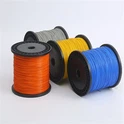
I often have customers (especially outdoor equipment manufacturers in North America and Europe) privately ask me: Can UL1332 tin plated FEP insulated wire be used directly outdoors? After all, I have dealt with many cases where outdoor equipment malfunctioned prematurely due to wire selection errors - for example, last year a garden equipment company in Florida used ordinary PVC insulated wire for outdoor irrigation controller wiring, which cracked and leaked electricity due to exposure to sunlight in less than 3 months. Later, it was replaced with UL1332 to completely solve the problem. Today, based on my practical experience, I will explain this matter to everyone.
Conclusion: UL1332 tin plated FEP insulated wire can be used outdoors and is suitable for most outdoor low-voltage scenarios. But it is not a 'universal product', whether it can be used for a long time and stably depends on the scenario matching and usage details - this is also what I want to focus on sharing with everyone, after all, from the actual supply and customer feedback, many people overlook these small details.
Let's briefly introduce this wire (source: UL official standard UL1332 and our outdoor scene supply data in the past 3 years): It is a special wire certified by American standard UL, with a core structure of tinned copper wire conductor+FEP insulation layer. Many customers think that "the wires are all the same", but it is these two core components that determine its ability to stand outdoors - especially the FEP insulation layer, which is different from ordinary PVC and PE insulation. Its weather resistance has been verified through practical scenarios.
Based on the customer cases I have encountered, let me talk about the outdoor scenarios it can handle and its performance in actual use: Last year, it supplied to an outdoor LED lighting manufacturer in California, whose streetlight wiring needed to be exposed to the edge of the desert for a long time. In summer, the surface temperature often reached over 45 ℃, and in winter, it would drop below 0 ℃ at night. At first, they were worried that the wire could not withstand temperature differences, so I suggested that they first test a 100 meter sample. After using it for 6 months, they provided feedback that the insulation layer of the wire had no signs of softening or brittleness, and the conductivity remained stable. Later, they purchased it in bulk.
This cannot be separated from its several core characteristics:
The range of high and low temperature resistance is -80 ℃ to 200 ℃, and it can work stably regardless of the high temperature in the California desert or the severe cold in Vancouver, Canada during winter;
FEP insulation layer does not absorb moisture (with a water absorption rate of less than 0.01%). Last year, we supplied UL1332 to a customer in Xiamen who exports coastal monitoring equipment. They used UL1332 for wiring coastal monitoring cameras, which has been corroded by salt spray for a long time. It has been used for more than a year without insulation layer damage or leakage.
There is also the advantage of tin plated conductors, which many customers do not pay much attention to, but is particularly important in outdoor humid environments. Previously, a customer used ordinary bare copper conductor wire. After less than 2 months of use in a humid outdoor environment, the conductor oxidized and turned black, causing frequent power outages to the monitoring equipment; After replacing with UL1332 tin plated conductors, the oxidation problem was completely solved, and the welding performance of tin plated conductors was better during subsequent equipment installation, resulting in a significant improvement in worker efficiency.
However, there are a few details that I must remind everyone of - not that I deliberately emphasized them, but that in recent years, there have been too many cases where wires were damaged prematurely due to neglecting these details:
1. Try not to use it directly buried underground unless it is equipped with a protective tube: Last month, a customer tried to save trouble by burying UL1332 directly in the garden soil. However, in less than a month, the insulation layer was scratched by the gravel in the soil. Fortunately, it was discovered in time and did not cause equipment failure. If it is indeed necessary to bury it underground, it is necessary to wear a protective tube, which is not expensive but can significantly extend its service life.
2. Do not pull too much when wiring. The conductor of UL1332 is a multi stranded wire with good flexibility. However, last year, an outdoor equipment installation team excessively pulled and stretched the wire to meet the deadline, resulting in some conductors breaking. The problem was only discovered during later debugging, which actually delayed the progress. In fact, as long as we operate normally and avoid brute force pulling, we can avoid this unnecessary trouble.
3. Pay attention to voltage matching. The rated voltage of UL1332 is 300V, suitable for outdoor low-voltage equipment such as LED street lights, small irrigation equipment, surveillance cameras, outdoor sensors, etc. Previously, a customer mistakenly used it for high-voltage outdoor equipment. Although there were no problems in the short term, there were safety hazards in long-term use. Later, they switched to a higher voltage level wire to feel at ease.


In addition to these, let me share another case that left a deep impression on me: a small outdoor testing equipment company in the Netherlands needed a wire that could be used for a long time in low temperature and humid environments. After comparing multiple products, they finally chose UL1332. Their equipment is used for suburban environmental monitoring and requires year-round exposure to the outdoors, with wind and rain being the norm. They have been using it for 2 years and the cables have not experienced any malfunctions. Customers have reported that it is "much more worry free than other cables used before".
Lastly, regarding the outdoor use of UL1332, there are not many complex techniques, the core is "matching the scene+paying attention to details". It is not a "divine wire", but in outdoor low-voltage scenarios, it is indeed a cost-effective choice - at least based on our supply data in the past 3 years, UL1332 used in outdoor scenarios has a failure rate of less than 3%, far lower than ordinary insulated wires.
If you have specific outdoor application scenarios, such as seaside, high temperature, cold areas, or are unsure if your equipment is compatible, you can talk to me. After all, I have been exposed to too many similar cases, perhaps I can give you some more practical advice to avoid taking detours.