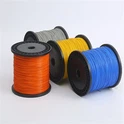
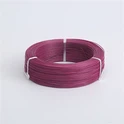
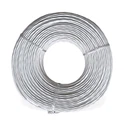
UL10358 single core copper wire has always been recognized as "hard core wire": ETFE insulation, temperature resistance up to 150℃, anti-aging, oil resistance performance, single core copper conductor conductive stability, moderate hardness, can adapt to high temperature, high demand electrical environment. Over the years of cable production, many customers have encountered the same problem: the quality of the wire is not a problem, but after wiring, there are frequent occurrences of heating, false connections, insulation damage, and even slow down equipment operation, burying safety hazards. In fact, this issue is not related to the wire itself, but rather a mismatch in wiring methods and inadequate control over details. Today we will talk about the standardized connection techniques of UL10358, which make the joint both firm and durable, and achieve zero conductivity loss, fully utilizing the high-performance advantages of the wire.
Before wiring, check your temper: Do not violate these rules
UL10358 single core copper wire is different from household flexible wire. The copper core is relatively hard, and the ETFE insulation layer has sufficient toughness. When peeling, be careful not to copy the old methods of ordinary wires. These basic requirements are prerequisites, and even one step less is prone to problems:
Firstly, do not damage the copper core when stripping the wire. Try to use specialized wire stripping pliers, adjust the gear according to the wire diameter, and do not cut or tear off the insulation layer with a knife or hand. Accidentally scratching the copper core can easily lead to breakage in the later stage. The stripping length should be controlled within 5-8mm. If it is too short, the crimping will not be firm, and if it is too long, there is a risk of leakage if the copper core is exposed. There is no need to memorize multiples, and the most practical way is to fit the size of the terminal and joint.
Secondly, the copper core must be wiped clean. Wires that have been stored for a long time and copper cores exposed to the air are prone to a layer of oxide film on their surface. Directly connecting them will increase the contact resistance and prevent the joints from becoming hot. Before wiring, gently rub the surface with fine sandpaper or wipe off any oil and dust with a dry cloth to ensure that the copper core is shiny and free of impurities. This step is the key to preventing heating.
Thirdly, do not forcefully break the copper core. Single core copper core has high hardness and is prone to hidden cracks when bent hard. In the later stage, when the equipment is powered on and vibrates, it will break directly. When bending, it should slowly bend along the curvature of the copper core to maintain its integrity and durability.


There are three commonly used connection methods on site, just use them correctly for the corresponding scenario
In actual construction, there is no need to pursue complex processes. Choosing the right scene, using the right method, and ensuring the stability of the joints are all common and acceptable compliant connection methods in the industry
Manual splicing+insulation wrapping (temporary wiring, small wire diameter emergency)
Suitable for UL10358 single core wires with a diameter of ≤ 1.5mm², commonly used for temporary wiring and simple internal wiring of equipment, without the need for specialized crimping tools, making it particularly convenient for on-site emergencies. Cross the two stripped copper cores, twist them together twice and straighten them, then wrap each wire end 5-6 times around the opposite copper core, press it tightly with pointed pliers, and cut off any excess burrs without pricking your hands. Insulation wrapping must use high-temperature resistant polyimide tape, with 3 layers of semi overlapping wrapping, starting from the root of the insulation layer, leaving no gaps to prevent the tape from aging and falling off under high temperature.
Copper conduit crimping (preferred for fixed wiring and high standard engineering)
This is the most recommended connection method for industrial control and cabinet wiring, with strong durability and good acceptance, and is an industry standard process. Choose an oxygen free copper sleeve that matches the wire diameter perfectly, align two cleaned copper cores and insert them into the sleeve, making sure to push it to the middle without leaving any gaps. Select the corresponding clamp for the crimping pliers, press vertically 2-3 times, and the indentation is uniform. If there are no cracks in the casing and the copper core is not exposed, it is qualified. After pressing, it is best to put on a high-temperature resistant heat shrink tubing, and use a hot air gun to blow evenly and tightly. The sealing performance is much better than tape, and it is fully compatible with the high-temperature working conditions of UL10358.
Terminal bolt fastening (distribution box, equipment terminal)
When connecting terminal blocks and distribution box terminals, this method is the most convenient and easy for later maintenance and disassembly. The stripped copper core should not be scattered, but should be bent into a circular ring with an inner diameter that fits snugly around the bolt. Install flat and spring washers, and use a wrench to evenly tighten the nut, avoiding loose and loose connections. Remember that the copper core should not be exposed, and the circular ring should be tightly attached to the plane of the terminal block to ensure that the contact surface is tightly sealed, and there will be no local overheating after power on.
Avoiding pitfalls guide: Even experienced technicians are prone to making mistakes
Based on common rework situations on site, these pitfalls are real lessons to be avoided:
- Don't use ordinary PVC tape to make up the difference : UL10358 can withstand temperatures up to 150℃, while ordinary PVC tape can only withstand temperatures up to 70℃. In high temperature environments, it will soften and peel off quickly, leading to direct insulation failure. It is necessary to use matching high-temperature resistant auxiliary materials.
- Strictly prohibit virtual twisting and loose copper core : Single core wires must be firmly attached when connected, leaving only gaps on the surface and inside. The resistance will definitely increase, and it will become hot after prolonged use.
- Do not press hard if the tool does not match : The small wire crimping pliers cannot press the large sleeve tightly at all. It is necessary to choose a professional wire crimping pliers of the corresponding specifications, and only when the force is sufficient can it be firmly pressed.
- Don't put too much force on the connector : When wiring, leave more wire length and don't let the connector pull or bend too hard, otherwise the copper core is prone to breakage and the connector is prone to loosening.
Conclusion
The inherent properties of UL10358 single core copper wire are quite robust. There is no special "secret recipe" for wiring; it's simply a matter of following the rules and ensuring proper details. Whether it's wiring for small devices or industrial engineering, as long as one follows the characteristics of the wire, selects the correct connection method, and ensures proper insulation protection, the connection points can remain stable for a long time. Problems such as poor connection, overheating, and insulation damage can all be avoided. By spending an extra minute during construction to polish the copper core, compact it, and wrap it properly, there will be much less trouble in terms of after-sales service and rework in the future.