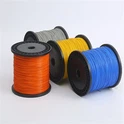
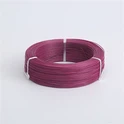
As a procurement or technical personnel in the fields of electronics, home appliances, and industrial automation, have you ever had the experience of spending money on genuine products but buying counterfeit UL1332 tin plated FEP insulated wire? Seemingly similar in appearance, there are hidden dangers: insulation layer melting in high temperature environments, inadequate conductivity, and even equipment short circuits and fires, which not only cause economic losses but may also sow the seeds of safety accidents.
UL1332 wire has become a "standard wire" for high temperature and harsh environments such as microwave ovens, air conditioners, industrial sensors, and aviation electronics due to its excellent high temperature resistance (rated temperature up to 200 ℃), oil resistance, corrosion resistance, and insulation performance. Its tin plated copper conductor is resistant to oxidation and stable conductivity, and the FEP insulation layer has the advantages of being insoluble in most organic solvents and low high-frequency loss. It is widely used in motor and electrical equipment wiring scenarios with AC rated voltage of 600V and below. Because of its wide application and high added value, counterfeit products are constantly emerging on the market, and the forgery methods are becoming increasingly covert, making it difficult for people to distinguish. Today, let's talk about how to identify counterfeit UL1332 tin plated FEP insulated wire?
The danger of counterfeit wires is much higher than you imagine. I once encountered a customer who installed counterfeit UL1332 wire in an oven. After only half a month of use, the insulation layer softened and leaked electricity, almost causing a fire.
The reason why counterfeit goods are deadly is because of cutting corners. Authentic products rely on the high temperature resistance and flame retardancy of FEP insulation layer, as well as the conductivity stability of high-purity tin plated copper. However, counterfeit products will use PVC and recycled plastics instead of FEP, and replace high-purity tin plated copper with miscellaneous copper and fine copper wire in order to lower costs. You should know that PVC material will soften and become sticky above 80 ℃, and cannot withstand the test of high-temperature equipment at all; Copper impurities have low purity, reduced wire diameter, and are prone to generate heat when powered on, which not only consumes electricity but may also burn out equipment; The insulation layer made of recycled plastic will age and crack soon, and leakage and breakdown are common occurrences, not to mention resisting oil stains and acid-base corrosion.
What's even more headache inducing is that some counterfeit goods deliberately imitate the appearance and printed labels of genuine products, and even forge UL certification numbers. Without mastering some identification skills, it's really easy to be fooled. The following methods are all summarized from my practical experience, simple and easy to operate, and can be directly applied by everyone.
Looking at the appearance is the most intuitive method of identification, and many flaws in counterfeit goods are actually hidden in the details. The production process of genuine products is very rigorous, and every part must comply with UL standards, while counterfeit products have rough craftsmanship to save costs, and the difference can be seen at a glance.
Let's talk about the insulation layer. The genuine FEP insulation layer has a smooth and uniform surface like a mirror, with a glossy finish. It is mostly semi transparent light amber or even milky white, and the entire wire color is consistent, without any impurities or layering of light and dark. The counterfeit products I have seen are either made of recycled plastic, with a grayish yellow color, rough surface, bubbles, pinholes, and even protrusions with twisted conductors inside; Either the color is too bright and uneven, which is actually due to the addition of excessive pigments to cover up material defects, and it may fade with just a wipe by hand. Of course, there are also a few genuine products that add a small amount of color masterbatch to block light, but the color is still uniform and there will be no local color difference.
Cutting open the wire to see the cross-section can also quickly distinguish. The genuine conductor is high-purity tin plated copper. After cutting, the copper wires are arranged tightly and evenly, and the tin plating layer is bright and full, without blackening, oxidation, or powder loss upon wiping. The cross-sectional color of the copper core is soft and free of impurities. But counterfeit goods are different. Most of them use recycled copper, which has a darker color and rust marks. The copper wires are arranged loosely and even cut corners. For example, the nominal 26AWG wire may have a total cross-sectional area of only 80% of the genuine copper wire, and its conductivity will only deteriorate over time.


There is also a printing label, which is a crucial anti-counterfeiting point. On the insulation layer of genuine products, there will be clear hot stamping or spray coding, including the "UL" logo, AWM 1332 model, 200 ℃ rated temperature, 300V rated voltage, manufacturer code starting with E, RoHS environmental protection label, all of which cannot be omitted. The font is clear and neat, and it will not fall off even after repeated wiping with nails, let alone any mistakes or omissions in printing. The labels of counterfeit goods are either blurry, crooked, or missing, some of which will fall off as soon as they are wiped off, and even have a fake UL certification number, making it impossible to trace the source.
Besides looking, you can also distinguish between good and bad by touching, which I emphasize every time I train clients. The difference in hand feel is really obvious. The genuine FEP insulation layer feels "soft and firm" to the touch, unlike hard plastics that are stiff or sticky. It can quickly rebound after pressing without leaving obvious pressure marks.
When bending, the feel is very smooth and there is no lag. No matter how it is bent, the insulation layer will not crack or turn white, and it is not easy to break even after repeated bending. But counterfeit goods will go to two extremes: one is made of inferior hard plastic, which feels hard to the touch and makes a "click" crisp sound when bent. It will break with a little force and leave obvious white marks at the bend, and even crack directly; Another type is recycled plastic with excessive plasticizers added, which feels soft and sticky to the touch, like a melted candle. Rubbing it with your hand will make one hand sticky, and over time it will stick to other things. This type of wire has extremely poor insulation and cannot be used in high-temperature environments.
Additionally, you can gently pull the wire to ensure that the genuine conductor and insulation layer are tightly bonded without loosening or falling off; But the insulation layer and conductor of counterfeit goods are poorly bonded, and they will separate with just a slight pull. Some can even easily peel off the insulation layer, exposing the copper wire inside. This type of wire must not be bought.
If you are still unsure about looking and touching, why not do two simple tests. The most crucial aspect is the high temperature resistance test, as the core advantage of UL1332 wire is its high temperature resistance, which is also the easiest place for counterfeit products to be exposed. You can find a home oven, put the wire sample in it, set it to 120 ℃ and bake for 30 minutes. You should know that the genuine product can withstand high temperatures of 200 ℃, and 120 ℃ is completely stress free for it; If you don't have an oven, you can use the high temperature setting of a hair dryer to blow the wire for 10 minutes.
After taking it out, you can tell by looking at its condition: the insulation layer of the genuine product has not changed at all, the surface is still smooth, not softening or sticking, and it still has elasticity when bent; But counterfeit goods, especially those made of PVC material, will significantly soften, deform, and even stick together. They will deform with just a pinch and cannot be restored to their original state. In severe cases, the insulation layer will directly fall off, exposing the copper wire inside. This type of wire used in high-temperature equipment is like burying a ticking time bomb.
Another one is flame retardant testing, which is related to safety and worth a try. FEP material itself has good flame retardancy, which is also an important safety guarantee for UL1332 wire. Ignite the insulation layer with a lighter, and when the genuine product burns, there are only slight melting marks, almost no obvious flames, and only a small amount of white smoke will be emitted. It will immediately extinguish when leaving the fire source, with no droplets or pungent odor, only a slight plastic smell.
But counterfeit goods are different. Whether it's PVC or recycled plastic, they will emit a large amount of black smoke and a pungent odor when ignited. They will continue to burn even after leaving the ignition source, with black droplets that can even ignite nearby paper and fabric. This is because counterfeit products do not meet the VW-1 flame retardant rating of UL standards, and if used on equipment, the consequences of a fire would be unimaginable.
If you have a multimeter at home, you can also test its conductivity. The resistance value of genuine UL1332 wire is very stable and meets UL standards; However, counterfeit products have significantly higher resistance values due to low copper wire purity and reduced wire diameter, which can fluctuate and generate heat when powered on for a long time, easily leading to equipment malfunctions.
Actually, compared to identifying after the incident, controlling in advance is the safest way to prevent counterfeit goods from the source, which is also something I have always reminded my purchasing friends of. After all, buying counterfeit goods and then reworking them not only costs money and effort, but may also delay the project schedule.
Firstly, we need to verify the authenticity of UL certification. On the insulation layer of genuine products, there will be a unique UL certification number. When purchasing, you can log in to the UL official certification catalog, enter the number to find the manufacturer, specifications, testing reports, and other information of the product. If the results cannot be found, or if the manufacturer's information does not match what the supplier said, it is definitely a fake and cannot be bought even if it is cheap. If purchasing in large quantities, suppliers can also provide a copy of the UL certification certificate, carefully checking whether the number, specifications, and wire identification on the certificate are consistent. If you are not confident, you can also contact the UL agency to verify the authenticity of the certificate.
Secondly, choosing the right supplier is crucial. Try to find suppliers with formal qualifications and good reputation, and ask them to provide product testing reports and production qualification certificates. Do not purchase from small workshops or intermediaries without qualifications, as the counterfeit rate in these channels is extremely high and there is no one to take responsibility for any problems. When I usually recommend suppliers to customers, I ask them to ask for the source of the raw materials. Genuine FEP insulation materials and high-purity tin plated copper have clear procurement traceability, while counterfeit raw materials have unknown sources and cannot provide relevant proof.
One more thing, don't be greedy for cheap things. The raw material cost of genuine UL1332 wire is not low and the price is relatively stable. If a supplier's quotation is more than 30% lower than the market average price, it is highly likely to be counterfeit. I have seen many customers who, due to their greed for cheap prices, bought counterfeit goods, and eventually their equipment malfunctioned, resulting in repair costs that were even higher than the money saved. It's really not worth the loss.
In fact, to identify counterfeit UL1332 tin plated FEP insulated wire, it relies on the four words "look, touch, test, and check". If you encounter any uncertainties during procurement and identification, you may refer to the above methods to investigate one by one, or you can contact regular suppliers for help. I hope this guide can help everyone avoid the procurement minefield and buy qualified and reliable UL1332, providing an additional guarantee for product quality.