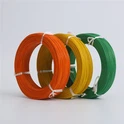
In the past few years of cable production, I have seen many customers wasting high-quality wires for nothing: UL1508 tin plated ETFE insulated wire, which was purchased at a high price, passed all the inspection indicators upon arrival. After being stored in the warehouse for more than half a year, it was discovered on the machine that the insulation layer was brittle and easy to crack, the conductor tin plating layer was dark and heavy, and there was no tin sticking during welding. The entire coil of wire could only be scrapped. This wire itself is resistant to high temperatures and corrosion, and its performance is not delicate. The vast majority of losses are due to negligence in storage details. Based on years of practical experience in warehouse inspections and on-site stocking, I would like to share with you some storage techniques to reduce wire performance loss.
Temperature control and moisturizing: Don't let the environment quietly damage the performance of the wire
The stability of ETFE insulation layer is indeed better than that of ordinary cables, but it cannot be stacked arbitrarily. Our warehouse conducts temperature and humidity monitoring year-round, and data review shows that significant fluctuations in temperature and humidity are the primary cause of premature aging of this wire. During the rainy season in the south, a batch of wires were temporarily piled up in the corner near the window without any moisture-proof protection. In less than four months, after peeling off the insulation layer, the tin plating layer of the conductor was visibly oxidized and blackened, and the conductivity resistance exceeded the standard, so it could only be scrapped.
The daily storage temperature should be as stable as possible between 5 ℃ and 35 ℃, without the need for deliberate constant temperature control. However, it is important to avoid areas with radiators, drying equipment, and direct sunlight. During high temperatures in summer, it is recommended to turn on fans for ventilation to prevent local heat accumulation from accelerating the brittleness of ETFE materials; In winter, if the temperature in the warehouse is low, there is no need to panic. As long as there is no frost or ice, the wires will not be damaged. Just place them in a room temperature area for half an hour before use to prevent the insulation layer from hardening and cracking during wiring due to low temperature.
Humidity control is more critical than temperature control. Our warehouse maintains a relative humidity of 40% -60% throughout the year. Industrial dehumidifiers are fully turned on in coastal areas and during rainy seasons. Two packs of desiccants are placed in each packaging box of the production line, and they are replaced regularly every two months. Based on the previous measured data of scrapped wires, it can be seen that if the environmental humidity exceeds 70% for a long time, the oxidation rate of the tin plating layer will significantly accelerate, and color difference can be visually observed in about six months. These are all real conclusions summarized from practical experience, not empty theoretical parameters.


Placement and storage: Do not let compression and collision leave hidden damage
UL1508 ETFE wire are mostly packaged in paper or plastic reels before leaving the factory. These reels have limited load-bearing capacity, and many people stack them flat to save storage space, which is the most common mistake. At a previous construction site where we worked together, we stacked three layers of fine gauge wire reels flat. The bottom layer of the reel was severely deformed due to compression, and the internal wires were tangled into knots. After forcibly disassembling, the insulation layer was covered in scratches and completely unusable.
The reel must be placed vertically, against the wall or fixed with shelves or baffles to prevent rolling and tipping; If the warehouse space is limited and stacking is required, a maximum of two layers are sufficient. Place a flat wooden board between the layers to prevent the upper layer of the wire reel from directly pressing on the lower layer of the wire body. Cut the remaining loose wires, do not bend them hard, coil them according to the original curvature, and put them in a sealed bag to prevent the insulation layer from being scratched and dust from entering.
Whether it is a whole or loose wire, it cannot be placed directly on the ground. Use wooden or plastic trays to elevate it by about 15 centimeters, which can not only isolate the moisture on the ground, but also avoid scratching the wire body with iron nails and gravel on the ground. When moving, don't throw or drag. Our warehouse handles goods with care to reduce hidden damage caused by collisions.
Isolation and protection: Keep away from sources of corrosion and ensure the quality of the wire
The ETFE insulation layer can withstand most conventional chemicals, but long-term exposure to volatile substances and oil stains will still gradually erode it. Our warehouse has designated a separate area for this special cable, which should not be piled up with paint, diluents, acid-base reagents, or lubricants. The volatile gases from these items can cause the insulation layer to lose its luster and the conductivity to be affected over time.
The original sealed packaging is recommended to be removed when in use, and then wrapped tightly with moisture-proof film to reduce contact between the thread and air. Especially in coastal areas with high salt spray, we will wrap the outer layer of the reel with rust proof paper, which can prevent salt spray and dust, and has been tested to effectively extend storage time. Wear gloves as much as possible when handling wires, and do not touch conductors directly with your hands. Sweat on your hands sticking to the tin plating layer can easily accelerate local oxidation.
Daily maintenance: simple inspections to reduce backlog and wear and tear
Daily maintenance does not require a complex inspection process. During monthly inspections, it is only necessary to simply check whether the wire reel packaging is damaged, whether the insulation layer has discolored or cracked, and whether the conductor has turned black or oxidized. For reels stored for more than three months, gently roll and rotate them to avoid hidden deformation caused by long-term local pressure.
When preparing goods, try to arrange them according to the date of manufacture, and use those that are stored first to avoid long-term backlog. Generally speaking, when stored properly, this wire has stable performance after about a year and a half. If stored for a longer period of time, simply test its insulation and conductivity before use to ensure that there are no problems before use.
At the end of the day, the storage of UL1508 tin plated ETFE insulated wire does not have a high threshold, it all depends on detail control. By stabilizing the temperature and humidity, regulating the placement posture, and staying away from the source of corrosion, combined with simple daily inspections, the quality of the wire can be firmly maintained at the factory, reducing material waste, and making subsequent wiring construction more worry free and secure.