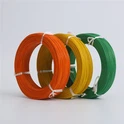
Yo, folks! I'm a supplier of UL10308 single core copper wire, and today I wanna chat about whether it's suitable for wireless charging applications.
First off, let's get a bit technical about what UL10308 single core copper wire is. This wire is known for its high - quality copper core. Copper is a fantastic conductor of electricity, and that's a major plus when it comes to any electrical application. It has low resistance, which means less energy is lost as heat during the flow of electricity.
When we talk about wireless charging, the basic principle is electromagnetic induction. An alternating current in a transmitting coil creates a magnetic field, and this magnetic field then induces a current in a receiving coil in the device being charged. For this process to work efficiently, the wires used in both the transmitting and receiving coils need to have good electrical conductivity.
The UL10308 single core copper wire's excellent conductivity makes it a strong candidate for wireless charging applications. Since it can carry the electrical current with minimal loss, it helps in maintaining the efficiency of the wireless charging system. When the power transfer from the charger to the device is more efficient, it not only charges the device faster but also reduces the amount of wasted energy, which is great for both the environment and your electricity bill.
Another important aspect is the flexibility of the UL10308 single core copper wire. In wireless charging setups, especially in consumer electronics like smartphones and smartwatches, the design often needs to be sleek and compact. The wire needs to be able to bend and fit into tight spaces without breaking or losing its electrical properties. Our UL10308 wire is quite flexible, which allows it to be easily integrated into the small and complex designs of modern wireless charging pads and the internal components of the devices.
However, there are also some challenges to consider. Wireless charging involves high - frequency alternating currents. At high frequencies, a phenomenon called the skin effect becomes significant. The skin effect causes the current to flow mainly near the surface of the conductor. In a single - core wire like UL10308, this could potentially limit the overall performance of the wireless charging system. To counter this, some manufacturers might prefer using multi - strand wires like the single core multi strand flexible copper cable. These multi - strand wires increase the surface area available for the current to flow, reducing the impact of the skin effect.


But don't count out the UL10308 single core copper wire just yet. For lower - power wireless charging applications, like charging small IoT devices or some low - end wireless earbuds, the skin effect might not be as much of an issue. The simplicity of a single core wire can also be an advantage in terms of cost and ease of manufacturing.
In addition, the UL10308 wire is often used in combination with other components in a wireless charging system. For example, it can be used in the wiring of the control circuits that manage the power flow and ensure the safety of the charging process. These control circuits don't always require the high - frequency performance that is crucial for the main charging coils. So, even if it might not be the best choice for the coils themselves in high - power applications, it can still play an important role in the overall wireless charging setup.
Now, let's talk about some alternatives in the market. There are other types of wires that are also used in wireless charging. For instance, high voltage flexible cable and unsheathed copper wire. While these wires have their own unique properties, the UL10308 single core copper wire stands out in terms of a balance between conductivity, flexibility, and cost.
If you're in the business of manufacturing wireless charging devices, you need to carefully evaluate your requirements. If you're targeting the mass - market, cost - effective solutions with lower power requirements, the UL10308 single core copper wire could be a great option. You can take advantage of its good conductivity and flexibility to create a reliable and inexpensive wireless charging product.
But if you're working on high - end, high - power wireless charging systems, you might need to combine the UL10308 wire with other types of conductors or use it only in the non - critical parts of the circuit.
In conclusion, the UL10308 single core copper wire has both its strengths and limitations when it comes to wireless charging applications. It's not a one - size - fits - all solution, but it definitely has a place in the market. Whether for its use in smaller, lower - power devices or in the auxiliary circuits of more complex systems, it offers a lot of value.
If you're interested in learning more about how our UL10308 single core copper wire can fit into your wireless charging projects, don't hesitate to get in touch. We're always happy to have a chat and discuss how we can meet your specific needs. Let's talk about how we can work together to make your wireless charging products even better!
References:
- Electrical Engineering textbooks on electromagnetic induction and power transmission
- Industry reports on the development of wireless charging technologies