Hey there! As a supplier of UL10316 single core copper wire, I often get asked this question: "Is UL10316 single core copper wire flexible?" Well, let's dive right into it and explore the flexibility of this type of wire.
First, let's understand: What exactly is UL10316 single core copper wire?
Before discussing flexibility, let's briefly explain UL10316- after all, many customers may only know the model and not be clear about its core features. When we talk about flexibility, let's also clarify the basic information.
UL10316 is a high-temperature electronic wire certified by Underwriters Laboratories in the United States, with the core positioning of "high temperature resistance, wear resistance, and easy installation". It is mainly used in various scenarios that require stable transmission of current, such as household appliances, industrial machinery, electronic instruments, energy storage systems, and even internal wiring in aerospace and marine equipment.
Its core structure is very simple:
- Conductor : Made of pure copper material (either bare copper or tinned copper), with a single core structure, but note that the "single core" here is not a thick copper wire, but is made up of multiple strands of thin copper wire twisted together (this is the key to its flexibility);
- Insulation layer : ETFE (tetrafluoroethylene ethylene copolymer) material, the biggest feature of this insulation layer is its thinness, toughness, and high temperature resistance. It can withstand extreme temperatures from -80 ℃ to 125 ℃, resist strong acids and alkalis, oil stains, and is not easily aged or cracked;
- Core parameters : Rated voltage of 600V, wire diameter ranging from 10AWG to 32AWG. The flexibility of different wire diameters varies greatly, which is also a common pitfall for many customers (such as using UL10316 with thick wire diameter to make equipment that requires frequent bending, naturally feeling that it is not flexible enough).
Summary: UL10316 single core copper wire is a versatile electronic wire that is resistant to high temperatures, manufacturing, and easy to install. Flexibility is one of its core supports for easy installation.
The key point is: How is the flexibility of UL10316 single core copper wire tested?
Test scenario 1: Conventional bending (most commonly used, such as internal wiring of equipment)
Take the most commonly used 22AWG and 24AWG UL10316 single core copper wires (these two specifications are the best-selling in foreign trade orders and can be used for both household appliances and small instruments), and gently bend them by hand to easily bend them into 90 ° or even 180 ° without any effort - softer than the ordinary wires we usually use, and they will not rebound too much after bending, and can be firmly fixed in the desired position.
For example, if your client is making small robots and needs to insert wires into the robot joints, UL10316 single core copper wire can easily pass through without jamming or breaking the insulation layer due to hardness. I had an Italian client before who was initially worried that it wasn't flexible enough to fit the compact space of robot joints. Later, they sent samples and after testing, they placed an order for 10000 meters, saying that it was much easier to install than the other types of wires they had used before.
Test scenario 2: Repeated bending (testing durability, such as frequently moving devices)
Many customers may worry about whether flexible wires are easy to break or become useless after repeated bending. It must be made clear that the flexibility of UL10316 is "flexible and durable", not "soft and fragile".
We conducted a simple test: taking a 26AWG UL10316 single core copper wire (tinned copper conductor), we repeatedly bent it 1000 times (simulating the frequent movement of equipment during daily operation, such as conveyor belts and power tool wiring), with a bending radius controlled at 5 times the wire diameter (meeting UL standard requirements). Finally, we found that the insulation layer did not crack, the conductor did not break, and the resistance change rate was less than 3%, which did not affect normal use at all.
Here is a reminder: if it is UL10316 with a thick wire diameter (such as 10AWG, 12AWG), the flexibility may be slightly lower - after all, the wire diameter is thick, and although there are many copper wire strands in the conductor, the overall hardness will be higher, which is suitable for scenarios that do not require frequent bending (such as fixed equipment wiring); And with a fine wire diameter (24AWG-32AWG), the flexibility can be fully stretched, making it suitable for scenarios that require flexible wiring and frequent bending, such as internal wiring for small electronic instruments and AI robots.
Test Scenario 3: Flexibility in Low/High Temperature Environments (Customer Focus)
Many customers, such as those in Europe, North America, and the Middle East, are concerned about the performance of wires under extreme temperatures - after all, their equipment may be used in high-temperature workshops, low-temperature warehouses, or even outdoor environments.
The measured results are very awesome: under the low temperature environment of -80 ℃, UL10316 single core copper wire can still maintain good flexibility, will not become brittle, will not break, and will still be smooth when bending; At a high temperature of 125 ℃, the insulation layer will not soften or adhere, and its flexibility will not decrease. It fully meets the requirements of UL standards and can also adapt to high-temperature equipment (such as internal wiring of electric ovens and industrial furnaces).
There was a client in the Middle East who worked on industrial heating equipment and required wires to be able to function normally in an environment of 120 ℃, as well as bend and fit into the narrow space of the equipment. We recommended him to use 20AWG UL10316 single core copper wire, which fully met his requirements after actual testing. We have returned the order several times and also introduced colleagues to come over.
What UL10316 single core copper wire can have such good flexibility?
1. Conductor structure : Its "single core" is not a thick copper wire, but multiple strands of thin copper wire twisted together (such as 22AWG UL10316, where the conductor is 17 strands of 0.16mm thin copper wire twisted together). The multi strand twisted structure, like the rope we usually use, is more flexible than a single thick rope, can be easily bent, and is not easily broken;
2. Insulation layer material : ETFE insulation layer is thinner and more resilient than ordinary PVC insulation layer, and will not be as rigid as PVC. When bent, it can deform along with the conductor without limiting flexibility, and it is also wear-resistant, anti-aging, and will not crack due to bending;
3. Production process : UL10316 copper wire adopts annealing process. After annealing treatment at 400-600 ℃, the hardness of the copper wire will be reduced, and the flexibility will be improved. Moreover, the twisted pitch has been optimized to ensure flexibility without affecting the conductivity performance - in simple terms, it is "soft but not soft, tough but not brittle", balancing flexibility and durability.
Selection and Avoidance Guide
Avoiding pitfall 1: Blindly pursuing "the softer the better" and choosing the wrong line diameter
Some customers think that "the better the flexibility, the better" and choose the thinnest 32AWG regardless of their equipment needs. However, the conductivity under the thin wire is limited and the carrying current is small. If used on high-power equipment, it is easy to heat up and burn the wire. The correct approach is to first consider the current requirements of the equipment, and then choose the wire diameter, taking into account flexibility and conductivity - for example, choose 18AWG-22AWG for high-power equipment and 24AWG-32AWG for small precision equipment.
Avoiding pitfall 2: Ignoring environmental temperature, mistakenly thinking that all scenarios can be used
The upper limit of high temperature resistance for UL10316 is 125 ℃. If the customer's equipment is used in an environment exceeding 125 ℃ (such as inside a high-temperature furnace), even if the flexibility is good, it will still age and crack. In this case, a higher temperature model (such as UL1332) should be recommended; If used in low-temperature environments (below -80 ℃), it also needs to be explained in advance.
Avoiding pitfall 3: Confusing "single core" and "multi-core", thinking that a single core is definitely not flexible
Many customers think that "single core copper wire" must be stiff when they hear it, but in fact, it is not - UL10316's single core is multi stranded, with much better flexibility than ordinary single core copper wire, and is more wear-resistant and heat-resistant than multi-core copper wire. We can send samples for customers to test, and then decide whether to purchase after testing.


Conclusion
In summary, for over 90% of customers, the flexibility of UL10316 single core copper wire is fully sufficient - it is not the softest wire, but it is one of the best solutions for "flexibility+high temperature resistance+wear resistance+easy installation".
If you are working in home appliances, industrial machinery, electronic instruments, or energy storage devices, and need to balance flexibility and high temperature resistance, UL10316 single core copper wire is definitely the first choice.
Additionally, please provide a few small details that customers may be concerned about (to enhance competitiveness):
- Supply capacity : Our factory has eight independent production lines and is capable of producing 80000 kilometers of UL10316 single core copper wire. Regular specifications (20AWG-26AWG) are available in stock, and customized specifications (such as special colors and special wire diameters) can be delivered in about 15 days. It is suitable for small and medium-sized customers to purchase in bulk and can also meet the large-scale order needs of large customers;
- Complete certification : In addition to UL certification, it has also passed ROHS and REACH certifications, and can smoothly clear customs for exports to Europe, America, the Middle East, Southeast Asia and other regions without the need for customers to worry extra;
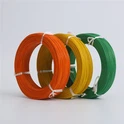
- Customization service : supports color customization (multiple colors such as red, black, white, yellow, blue, etc.), length customization (can be cut into 305 meters/roll, 610 meters/roll, etc. according to customer needs), and also provides free samples for customers to test flexibility and performance, dispelling concerns.
If your next project requires the purchase of UL10316 single core copper wire, please feel free to contact us at any time( luna@ironflon.com )We can provide professional advice based on your specific needs, such as diameter, length, and quantity.
References
General knowledge about copper wire properties and electrical cable standards.
- Manufacturer's specifications and technical data for UL10316 single core copper wire.