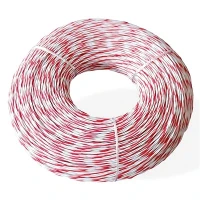
Yo! I'm a supplier of single core copper wire, and today I wanna chat about the applications of single core copper wire in the power industry. Copper has long been a top choice in electrical applications, and single core copper wire is no exception.
Power Transmission
One of the most fundamental applications of single core copper wire in the power industry is power transmission. Copper's excellent electrical conductivity makes it ideal for carrying electricity over long distances. When electricity is generated at power plants, it needs to be transported to homes, businesses, and industries. Single core copper wires are used in overhead power lines and underground cables for this purpose.
Overhead power lines are a common sight in many areas. These lines use large - gauge single core copper wires. The high conductivity of copper means that there is less power loss during transmission. Power loss in a conductor is proportional to the resistance of the conductor, and since copper has low resistance, it helps to keep the energy efficiency high. For example, in a rural area where power needs to be sent from a remote power station to a small town, single core copper wires can ensure that a significant amount of the generated power reaches the destination.
Underground cables also rely on single core copper wire. They are often used in urban areas where space is limited and aesthetics are a concern. The single core copper wire in these cables is usually insulated to prevent short - circuits and ensure safety. The insulation materials can vary, but common ones include polyethylene or PVC. These insulated single core copper wires can be buried underground without being affected by environmental factors such as moisture and temperature changes.
Electrical Wiring in Buildings
Another major application is in the electrical wiring of buildings. Whether it's a residential home, a commercial office building, or an industrial facility, single core copper wire is widely used. In a residential setting, it is used to connect electrical outlets, switches, and light fixtures. Copper's flexibility allows it to be easily bent and routed through walls, floors, and ceilings.
For instance, when you install a new light fixture in your living room, the single core copper wire is used to connect the fixture to the electrical panel. The wire is usually color - coded to indicate its function. For example, black wires are often used for hot wires, white for neutral, and green or bare copper for ground. This color - coding system makes it easier for electricians to install and troubleshoot the wiring.
In commercial buildings, single core copper wire is used for more complex electrical systems. Large office buildings may have multiple floors with different electrical requirements. Single core copper wires are used to distribute power to different areas such as offices, conference rooms, and data centers. The reliability of copper ensures that the electrical systems in these buildings operate smoothly, reducing the risk of power outages.
Transformers
Transformers are crucial components in the power industry, and single core copper wire plays an important role in them. Transformers are used to change the voltage of an electrical current. They consist of primary and secondary windings, and these windings are often made of single core copper wire.
The high conductivity of copper allows for efficient transfer of electrical energy between the primary and secondary windings. In a step - up transformer, which increases the voltage, the single core copper wire in the secondary winding has more turns than in the primary winding. Conversely, in a step - down transformer, which decreases the voltage, the primary winding has more turns.
For example, in a power substation, large transformers are used to step down the high - voltage electricity from the power grid to a lower voltage suitable for distribution to homes and businesses. The single core copper wire in these transformers is carefully wound to ensure optimal performance. The copper wire's ability to handle high currents without overheating is essential for the safe and efficient operation of the transformers.


Motors and Generators
Single core copper wire is also widely used in motors and generators. Motors convert electrical energy into mechanical energy, while generators do the opposite, converting mechanical energy into electrical energy.
In motors, the single core copper wire is used to create magnetic fields. When an electric current passes through the wire, a magnetic field is generated. This magnetic field interacts with other magnetic fields in the motor to produce rotational motion. For example, in a small electric fan motor, the single core copper wire is wound around the motor's stator and rotor. The number of turns and the gauge of the wire are carefully selected to achieve the desired motor performance.
Generators work on a similar principle. When a conductor (in this case, single core copper wire) is moved through a magnetic field, an electric current is induced in the wire. In large power generators at power plants, huge coils of single core copper wire are used to generate large amounts of electricity. The high conductivity of copper ensures that the generated electricity can be efficiently collected and sent out to the power grid.
Specialized Applications
There are also some specialized applications of single core copper wire in the power industry. For example, single core multi strand flexible copper cable is used in applications where flexibility is required. This type of cable is made up of multiple strands of single core copper wire, which makes it more flexible than a solid single core wire. It is often used in movable electrical equipment, such as industrial robots or portable power tools.
UL10584 single core wire is designed to meet specific safety and performance standards. It is commonly used in applications where reliability and safety are of utmost importance, such as in critical electrical systems in hospitals or data centers.
high voltage flexible cable is used in high - voltage applications. These cables can handle high voltages without breaking down, making them suitable for use in power transmission lines and high - voltage electrical equipment.
Why Choose Our Single Core Copper Wire
As a supplier of single core copper wire, I can tell you that our products are top - notch. We source the highest - quality copper and use advanced manufacturing processes to ensure the best performance of our wires. Our wires have excellent conductivity, low resistance, and high flexibility. They are also properly insulated to ensure safety.
If you're in the power industry and looking for reliable single core copper wire for your projects, whether it's for power transmission, building wiring, transformers, motors, or any other application, don't hesitate to get in touch. We can provide you with the right products at competitive prices. Let's have a chat about your requirements and see how we can work together.
References
- "Electrical Wiring Handbook" by Rex Miller
- "Power System Analysis and Design" by J. Duncan Glover, Mulukutla S. Sarma, and Thomas J. Overbye
- "Transformers: Theory, Design, and Application" by John D. McDonald