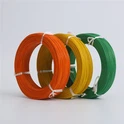
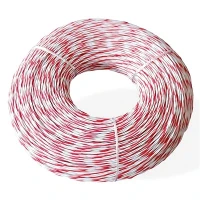
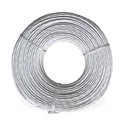
Hey there! As a supplier of UL10584 single core copper wire, I've often been asked about the differences between this type of wire and others on the market. So, I thought I'd share some insights to help you understand what makes UL10584 stand out.
1. Conductivity
First of all, we need to clarify a small common sense: the conductivity directly determines the "transmission efficiency" of the wire - the higher the conductivity, the less loss and heat generated when the current passes through, which is simply "more energy-efficient and durable". The core advantage of UL10584 single core copper wire is a significant advantage in terms of material.
First, let's take a look at UL10584 itself: it uses high-purity soft copper wire and has undergone tin plating treatment on the surface. At room temperature, its conductivity can reach around 58.0 MS/m, and its resistivity is only 0.017 Ω· mm ²/m, making it one of the top conductivity types. For example, with the same cross-sectional area (such as 1.25mm ²) and length, UL10584 can transmit electrical energy with losses more than 30% lower than ordinary wires, and long-term use will not accelerate aging due to severe heating. It is particularly suitable for scenarios that require high power supply stability, such as industrial production lines and data centers.
Compared to other common wires, the difference immediately becomes apparent. Let's divide it into several points:
- vs Aluminum Core Wire : The conductivity of aluminum is only about 61% of that of copper (about 37.7 MS/m), and its resistivity is much higher than that of copper. For the same transmission demand, aluminum core wires need to be made thicker to achieve the same efficiency as UL10584. Moreover, after long-term use, aluminum will oxidize, and joints are prone to loosening, heating, and even safety hazards. This is also why aluminum core wires are rarely used in foreign industrial projects, as no one wants frequent maintenance in the later stage to save some costs.
- vs Ordinary Copper Core Wire (Non UL10584) : Although ordinary copper core wire is also made of copper material, its purity and process are not as good as UL10584. Its conductivity is about 5% -10% lower, and it has not been tin plated. After long-term use, the conductor is prone to oxidation, especially in humid and high temperature environments, and its conductivity will gradually decrease, making it less stable than UL10584.
- vs Multi core copper wire : Multi core copper wire is made up of multiple thin copper wires twisted together. In theory, its conductivity is similar to that of single core copper wire. However, due to the small gaps at the twisted points, there will be slight losses when current passes through. Moreover, the skin effect of multi-core wire is more obvious (in simple terms, current is more likely to concentrate on the surface of the conductor), and the efficiency of long-term high current transmission is slightly lower than that of UL10584 single core copper wire.
To summarize: In terms of conductivity and transmission efficiency, UL10584 single core copper wire is more stable than aluminum core wire, slightly better than ordinary copper core wire and multi-core copper wire, suitable for scenarios with high requirements for energy loss and power supply stability - after all, electricity and equipment maintenance costs are pure profits saved!
2. Flexibility
Whether it's industrial installation or building wiring, the flexibility of wires is too important - you can't encounter corners or narrow spaces where wires can't bend or break easily, right? UL10584 single core copper wire has a particularly good balance in flexibility, let's compare it.
Let's take a look at UL10584: It uses a soft copper wire conductor and has a single structure, not multiple twisted wires. Although it is a single core, due to the soft texture of the copper wire and the flexible insulation layer itself, it is particularly easy to bend and can easily handle various corners, narrow spaces, such as internal wiring of equipment, hidden wires in walls, and even scenarios that require slight twisting. Moreover, it will not rebound or break after bending, saving a lot of effort during construction.
Compare three common types of wires and see the differences:
- vs Multi core copper wire : Multi core copper wire is slightly more flexible than UL10584 because it is made up of multiple thin copper wires twisted together, allowing for more complex bending, such as wrapping around equipment components. But the disadvantages are also obvious: twisted copper wires are prone to unraveling, especially during wiring and cutting, requiring additional treatment, and after long-term repeated bending, the twisted part is prone to breakage, affecting its service life.
- vs Aluminum Core Wire : Aluminum core wire has a lot of flexibility, and its texture is relatively hard. When bent, it is easy to crease or even break directly, and it cannot be restored to its original state after bending. Construction is particularly difficult, especially in narrow spaces, where it is almost impossible to operate - this is also one of the important reasons why aluminum core wire is gradually being phased out.
- vS PVC insulated single core copper wire : Ordinary PVC insulated single core copper wire, although the conductor is also copper, the PVC insulation layer is relatively hard, especially in low temperature environments, it will become more brittle, and it is easy to crack the insulation layer when bent. However, the ETFE insulation layer used in UL10584 still remains flexible at low temperatures, and its flexibility is stable regardless of high or low temperature environments.
Additional sentence: The flexibility of UL10584 perfectly balances "ease of construction" and "durability" - unlike multi-core wires that are prone to loose threads, and unlike aluminum core wires or ordinary PVC wires that are stiff, both professional construction teams and novice operators can easily get started, greatly improving construction efficiency.


3. Temperature Resistance
For wires, heat resistance is directly related to their service life and safety - especially in industrial equipment, high-temperature workshops, kitchens, computer rooms, and other places where wires are exposed to high temperatures for a long time. If the heat resistance is poor, the insulation layer is prone to melting, aging, and even causing short circuits and fires, with unimaginable consequences. The heat resistance of UL10584 single core copper wire is one of its "ace advantages".
First, let's take a look at the core parameters of UL10584: according to UL standards and product specifications, its rated temperature is up to 150 ℃, rated voltage is 600V, and it can withstand 2000V AC voltage and withstand voltage testing for 5 minutes. In an environment of 20 ℃, the minimum insulation resistance can reach 1000M Ω - km. Even if it works in a high temperature environment above 100 ℃ for a long time, it can maintain stability, the insulation layer will not melt or crack, and the conductor will not oxidize or be damaged due to high temperature.
Compared to other types of wires, the difference in heat resistance is very obvious. Let's explain each point clearly for everyone to compare and choose:
- Vs ordinary PVC insulated wire : The rated temperature of ordinary PVC wire is only 70 ℃ -90 ℃. Beyond this temperature, the PVC insulation layer will soften, deform, and even release toxic gases. Long term high temperature use will quickly age, and the service life is only 1-3 years. It cannot be used in high temperature scenarios - such as internal wiring of industrial equipment, where the temperature can easily exceed 100 ℃. With ordinary PVC wire, problems will occur within six months.
- Vs Aluminum Core Wire : The heat resistance of aluminum core wire is much worse than that of copper core wire. The rated temperature is generally only around 70 ℃. In high temperature environments, aluminum conductors are prone to oxidation, and the joints will heat up and loosen. In addition, the insulation layer (mostly made of PVC) is prone to aging, and its safety and durability are greatly compromised, making it completely incomparable to UL10584.
- Vs other UL series wires (such as UL1283, UL2464) : These UL certified wires have a rated temperature of around 105 ℃. Although they also comply with UL safety standards, they are much lower than UL10584's 150 ℃ and suitable for ordinary temperature scenarios. However, if it is a high-temperature environment (such as near a boiler or a high-temperature production line), UL10584 still needs to be selected to ensure long-term stable use.
A small suggestion: If your project involves high temperature environments or equipment generates a large amount of heat during operation, be sure to choose UL10584 single core copper wire - its heat resistance not only extends the service life of the wire, but also avoids safety hazards caused by high temperature aging. It can save costs by not replacing wires frequently in the later stage.
4. Safety and Certification
The safety and certification of wires are absolutely of utmost importance - after all, different countries and regions have different electrical safety standards, especially in the North American market (the United States, Canada). Wires without UL certification cannot enter the market or even pass engineering acceptance. One of the biggest advantages of UL10584 single core copper wire is its "built-in UL certified buff", which ensures full safety performance.
Let's first talk about the safety and certification details of UL10584: it fully complies with the UL 758 standard (North American wire and cable safety standard), has passed UL's strict safety tests, including voltage resistance testing, flame retardant testing, insulation layer aging testing, conductor oxidation testing, etc., and also meets RoHS environmental protection standards. It does not contain harmful substances and can meet safety requirements whether used in industrial, commercial, or civilian scenarios. In addition, the insulation layer of UL10584 is ETFE, which has good flame retardancy and will not burn quickly in case of fire. It can also reduce smoke production, effectively delay the spread of fire, and protect equipment and personnel safety.
The difference in certification and safety performance compared to other types of wires directly determines whether it can be exported and used in high-end projects
- Vs Non UL certified wires : Many ordinary wires (such as some domestic miscellaneous copper core wires and aluminum core wires) do not have any international certification, and even do not meet domestic safety standards. Not only can they not be exported to North America, Europe and other regions, but even if used domestically, there are also significant safety hazards - such as inadequate insulation layer thickness, insufficient conductor purity, which can easily cause short circuits and fires. For foreign customers, this type of wire cannot be used at all, as it cannot pass engineering acceptance and market access.
- Vs Aluminum Core Wire : Most aluminum core wires do not have UL certification and have many safety hazards, such as joint oxidation and heat generation, which can easily cause poor contact and short circuits. In addition, aluminum has a lower melting point than copper and is prone to melting at high temperatures, making it far less safe than UL10584 single core copper wire. Even if a small number of aluminum core wires are certified, it is difficult to pass the strict testing in the North American market.
- Compared to regular UL certified multi-core wire : Although multi-core wire also has UL certification, its safety performance is slightly inferior to UL10584- the twisting point of multi-core wire is prone to water and dust ingress, and after long-term use, it will oxidize and short-circuit. Moreover, its flame retardancy is slightly worse than UL10584's ETFE insulation layer, and the safety risk is higher in high temperature and humid environments.
Special reminder: If you are doing an export project, especially to the North American market, you must choose UL certified wires. UL10584 single core copper wire not only meets UL standards, but also RoHS environmental requirements. Whether it is engineering acceptance or market access, it can be easily passed without worrying about certification issues - just like having an "international pass", exporting is worry free.
5. Cost
Cost is always a factor when choosing a wire. UL10584 single core copper wire is made of copper, which is a relatively expensive material compared to some alternatives like aluminum. However, the cost needs to be considered in relation to its performance and benefits.
As mentioned earlier, its high conductivity and energy - efficiency can lead to long - term savings in power consumption. Also, its durability and safety features mean that you may not need to replace it as often as some cheaper, lower - quality wires. In the long run, the investment in UL10584 single core copper wire can be a smart decision, especially for applications where reliability and performance are crucial.
6. Installation
Installing UL10584 single core copper wire is relatively straightforward. Its single - core structure makes it easy to strip the insulation and make connections. The flexibility of the wire also allows it to be easily routed through conduits or other tight spaces.
In contrast, multi - conductor wires or cables with complex designs can be more difficult to install. You need to be careful not to damage the individual conductors, and the process of making proper connections can be more time - consuming. When it comes to quick and easy installations, UL10584 single core copper wire has an edge.
Conclusion
After talking so much, I believe everyone now understands the difference between UL10584 single core copper wire and other types of wires. Finally, let's summarize and help foreign clients quickly determine whether they should choose UL10584:
Firstly, the core advantages of UL10584 single core copper wire include high conductivity (energy-saving), moderate flexibility (easy construction), ultra-high heat resistance (durability), UL+RoHS dual certification (worry free export), low long-term use cost (worry free), and simple installation (labor-saving). The disadvantage is that the short-term unit price is higher than that of ordinary wires.
If you are in the following situations, it is strongly recommended to choose UL10584 single core copper wire:
- For export projects, especially to North American markets (such as the United States and Canada), UL certification is required to ensure engineering acceptance and market access;
- The project involves high-temperature environments (such as industrial production lines, near boilers, and computer rooms), requiring wires to have good heat resistance to avoid high-temperature aging;
- High requirements for power supply stability and energy loss (such as data centers, high-end equipment, commercial buildings), hoping that the wires can be used stably for a long time to reduce maintenance costs;
- The installation environment is complex (narrow space, multiple corners), requiring good flexibility of wires, simple installation, and saving construction time and labor costs.
If your project is for short-term temporary use, does not have high requirements for performance, safety, and certification, and has a limited budget, you can also consider ordinary PVC copper core wire; But it is absolutely not recommended to choose aluminum core wire, as it is prone to safety hazards in the later stage and is more expensive and troublesome.
Finally, let me reiterate: the choice of wires is never "the cheaper the better", but "the one that suits oneself is the best". For customers, UL10584 single core copper wire, although slightly higher in initial investment, its performance, safety, and durability can help you save a lot of electricity, maintenance, and replacement costs in the later stage. Moreover, UL certification allows you to export worry free. Whether from the perspective of cost-effectiveness or safety, it is a very worthwhile choice for wires.
If you have any further questions about UL10584 single core copper wire, such as specific specifications, applicable scenarios, and price details, please feel free to contact me( luna@ironflon.com )I will answer everyone one by one~I hope this article can help friends choose the right wires and avoid detours!
References
- Electrical Wiring Handbook, various editions
- Underwriters Laboratories standards documentation for UL10584.