


Yo, what's up everyone! I'm a supplier of UL1671 tin plated ETFE insulated wire, and today I wanna chat about one of the most important technical aspects of this wire: the attenuation constant.
First off, let's quickly go over what UL1671 tin plated ETFE insulated wire is. It's a type of wire that's widely used in various industries because of its great features. The UL1671 is a standard that ensures the wire meets certain safety and performance requirements. The tin plating gives it good corrosion resistance, and the ETFE insulation is known for its high temperature resistance, chemical resistance, and low friction properties.
So, what exactly is the attenuation constant? Well, in simple terms, the attenuation constant measures how much the signal strength decreases as it travels along the wire. You can think of it like this: when you shout from one end of a long hallway, your voice gets quieter as it moves further away. That's similar to what happens to an electrical signal in a wire. The attenuation constant tells us how quickly that signal "quiets down."
The attenuation constant is super important, especially in applications where signal integrity is crucial. For example, in high - speed data transmission or communication systems, a high attenuation constant can lead to a loss of data or a degradation in the quality of the signal. You don't want your important data to get all messed up because the wire can't carry the signal properly, right?
Now, the attenuation constant of UL1671 tin plated ETFE insulated wire depends on several factors. One of the main factors is the frequency of the signal. As the frequency increases, the attenuation constant usually goes up too. This is because at higher frequencies, the electrical properties of the wire, like its resistance and capacitance, start to have a bigger impact on the signal.
Another factor is the length of the wire. It's pretty obvious that the longer the wire, the more the signal will attenuate. If you have a short piece of wire, the signal doesn't have to travel as far, so there's less chance for it to weaken. But if you're using a really long wire, say in a large building or a long - distance communication setup, you need to be extra careful about the attenuation.
The quality of the tin plating and the ETFE insulation also play a role. A good quality tin plating can reduce the resistance of the wire, which in turn can help to keep the attenuation constant lower. And high - quality ETFE insulation can minimize the interference and energy loss within the wire, contributing to better signal transmission.
Let me give you an example to illustrate the importance of the attenuation constant. Suppose you're setting up a local area network (LAN) in an office building. You're using UL1671 tin plated ETFE insulated wire to connect all the computers. If the attenuation constant of the wire is too high, the network speed will be slow, and you might experience a lot of dropped connections. Your employees won't be happy, and the productivity of the whole office could be affected.
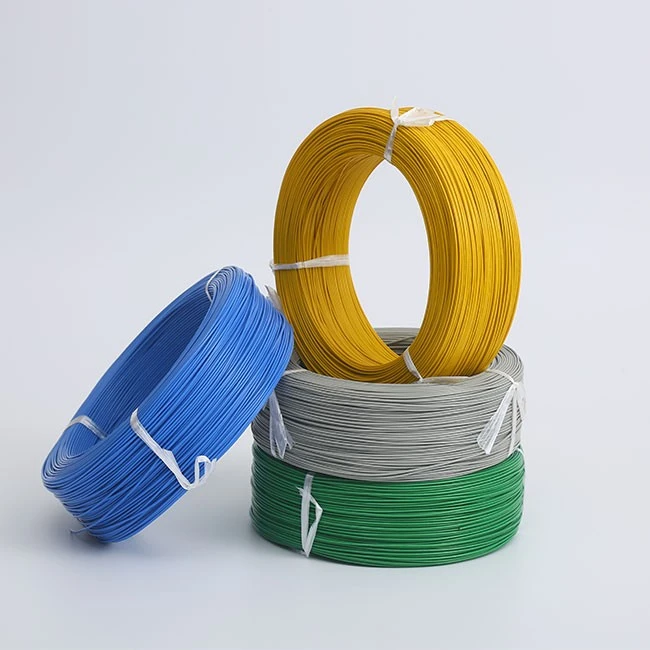

As a supplier, I know how important it is to provide wires with a low attenuation constant. That's why we put a lot of effort into the manufacturing process. We make sure that the tin plating is evenly applied and of the right thickness, and the ETFE insulation is of the highest quality.
Now, if you're in the market for UL1671 tin plated ETFE insulated wire, you might also be interested in some of our other products. We have the UL10109 Tin Plated ETFE Insulated Wire and the UL10126 Tin Plated ETFE Insulated Wire. These wires also have great performance characteristics and are suitable for different applications. And if you don't need the tin plating, we also offer the UL10126 ETFE Insulated Wire.
If you're looking for a reliable supplier of high - quality wires with a low attenuation constant, you've come to the right place. Whether you're working on a small DIY project or a large - scale industrial installation, we can provide you with the right wire for your needs. We understand the importance of getting the job done right, and we're committed to helping you succeed.
So, if you're interested in our UL1671 tin plated ETFE insulated wire or any of our other products, don't hesitate to reach out for a chat. We can discuss your specific requirements, answer any questions you might have, and work together to find the best solution for your project.
References:
- Electrical Engineering textbooks on signal transmission and wire properties
- Industry standards and guidelines related to UL1671 and ETFE insulated wires


