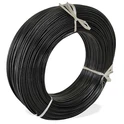
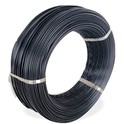
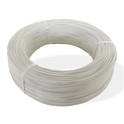
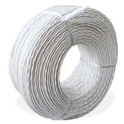
PTFE (Polytetrafluoroethylene) insulated wire is a high-performance electrical wire widely used in various industries due to its excellent properties. As a PTFE insulated wire supplier, I often receive inquiries about the density of PTFE insulated wire. In this blog post, I will delve into the concept of density in relation to PTFE insulated wire, its significance, and other related aspects.
Understanding Density
Density is defined as the mass per unit volume of a substance. In the context of PTFE insulated wire, it refers to the amount of mass contained within a specific volume of the wire, including both the conductor and the PTFE insulation. The density of a material is typically expressed in grams per cubic centimeter (g/cm³) or kilograms per cubic meter (kg/m³).
Density of PTFE
PTFE itself has a relatively high density compared to some other common insulation materials. The density of pure PTFE is approximately 2.1 - 2.3 g/cm³. This high density is due to the unique molecular structure of PTFE, which consists of carbon and fluorine atoms arranged in a very compact and stable manner. The strong carbon - fluorine bonds contribute to the material's high density and also give it many of its desirable properties, such as chemical resistance, high temperature resistance, and low friction.
Factors Affecting the Density of PTFE Insulated Wire
-
Conductor Material
The type of conductor used in the wire has a significant impact on its overall density. Common conductor materials include copper, aluminum, and nickel - plated or silver - plated conductors. Copper has a density of about 8.96 g/cm³, while aluminum has a much lower density of around 2.7 g/cm³. If a PTFE insulated wire uses a copper conductor, the overall density of the wire will be higher compared to one with an aluminum conductor, all other factors being equal. -
Insulation Thickness
The thickness of the PTFE insulation also affects the density of the wire. A thicker layer of PTFE insulation will increase the volume of the wire occupied by the insulation material, and since PTFE has its own density, this will contribute to the overall density of the wire. For example, if we have two wires with the same conductor but different insulation thicknesses, the wire with the thicker insulation will have a higher overall density. -
Additives in PTFE
Sometimes, additives are added to PTFE to improve certain properties such as mechanical strength or flame retardancy. These additives can change the density of the PTFE insulation. If the additives have a different density than pure PTFE, they will either increase or decrease the overall density of the insulation and, consequently, the density of the wire.
Significance of Density in PTFE Insulated Wire
-
Weight and Handling
The density of PTFE insulated wire affects its weight. In applications where weight is a critical factor, such as aerospace or portable electronic devices, a lower - density wire may be preferred. A lighter wire can reduce the overall weight of the equipment, which can lead to energy savings, better fuel efficiency in vehicles, or easier handling and installation. -
Thermal Properties
The density of the wire can also influence its thermal properties. A higher - density wire may have better heat dissipation characteristics in some cases because it has more mass to absorb and conduct heat. However, this also depends on other factors such as the thermal conductivity of the materials used. -
Cost
Density can be related to cost. Materials with higher densities may be more expensive due to the amount of raw material required. For example, copper conductors are more expensive than aluminum conductors in part because of their higher density and the associated higher cost of the raw material.
Comparing with Other Insulated Wires
When comparing PTFE insulated wire with other types of insulated wires, such as silicone insulated cable, the density differences can be quite significant. Silicone rubber has a density of around 1.1 - 1.6 g/cm³, which is lower than that of PTFE. This means that silicone insulated cables are generally lighter than PTFE insulated wires. However, PTFE offers better chemical and high - temperature resistance compared to silicone rubber.
Single core power cables may also have different densities depending on their construction. If they use different insulation materials or conductor types, the overall density can vary widely. For example, a single - core power cable with a polyethylene insulation may have a lower density than a PTFE insulated single - core cable.
UL1199 silver plated cable combines the properties of silver - plated conductors and PTFE insulation. The silver plating adds to the overall density of the conductor, and when combined with the PTFE insulation, it results in a wire with specific density characteristics. Silver has a density of about 10.49 g/cm³, so a UL1199 silver - plated cable will have a relatively high overall density compared to some other types of wires.
Measuring the Density of PTFE Insulated Wire
To measure the density of PTFE insulated wire, one can use the following general steps:
- Measure the Mass
Use a precise balance to measure the mass of a known length of the wire. Make sure the wire is clean and dry to get an accurate measurement. - Measure the Volume
The volume of the wire can be calculated by measuring its dimensions. For a cylindrical wire, the volume formula is (V=\pi r^{2}h), where (r) is the radius of the wire (including the insulation) and (h) is the length of the wire. In practice, more accurate methods may be required, especially for wires with complex cross - sectional shapes. - Calculate the Density
Once the mass (m) and volume (V) are known, the density (\rho) can be calculated using the formula (\rho=\frac{m}{V}).
Applications Based on Density Considerations
-
Aerospace Industry
In the aerospace industry, where weight is of utmost importance, PTFE insulated wires with lightweight conductors like aluminum may be preferred. These wires need to have good electrical and thermal properties while keeping the weight to a minimum. The density of the wire is carefully considered during the design and selection process to ensure optimal performance of the aircraft or spacecraft. -
Industrial Equipment
In industrial settings, the density of PTFE insulated wire may not be as critical as in aerospace applications. However, in some cases, such as in large - scale electrical systems where space is limited, a higher - density wire may be acceptable if it offers better mechanical and electrical properties. For example, in high - power electrical motors, PTFE insulated wires with copper conductors can handle high currents and are more robust due to their higher density and better electrical conductivity.
Conclusion
The density of PTFE insulated wire is a complex parameter that is influenced by the conductor material, insulation thickness, and any additives in the PTFE. Understanding the density of PTFE insulated wire is important for various reasons, including weight management, thermal performance, and cost considerations. As a PTFE insulated wire supplier, we take these factors into account when developing and manufacturing our products to meet the diverse needs of our customers.
If you are interested in purchasing PTFE insulated wire or have any questions about our products, we encourage you to contact us for a detailed discussion. Our team of experts can provide you with the most suitable solutions based on your specific requirements.


References
- "Handbook of Polymer Science and Technology"
- "Electrical Wiring Handbook"