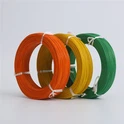
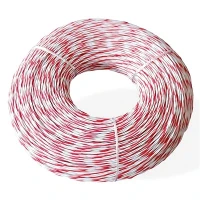
As a supplier of single core copper wire, I often get asked about the impedance of our products. Impedance is a critical parameter in electrical systems, and understanding it is essential for anyone working with single core copper wires. In this blog post, I'll delve into what impedance is, how it affects single core copper wires, and why it matters in various applications.
Understanding Impedance
Impedance, denoted by the symbol Z, is a measure of the opposition that a circuit presents to the flow of alternating current (AC). It is a complex quantity that combines resistance (R), inductive reactance (XL), and capacitive reactance (XC). The formula for impedance is (Z = \sqrt{R^{2}+(X_{L}-X_{C})^{2}}).
Resistance is the opposition to the flow of direct current (DC) and is caused by the collisions of electrons with the atoms in the conductor. In a single core copper wire, resistance is determined by the wire's length, cross - sectional area, and the resistivity of copper. The resistivity of copper is relatively low, which makes it an excellent conductor.
Inductive reactance occurs when a changing current in a wire creates a magnetic field around it. This magnetic field induces an electromotive force (EMF) that opposes the change in current. The inductive reactance (X_{L}=2\pi fL), where f is the frequency of the AC signal and L is the inductance of the wire.
Capacitive reactance, on the other hand, is related to the capacitance between the wire and its surroundings. When a voltage is applied across a wire, an electric field is created, and charge is stored. The capacitive reactance (X_{C}=\frac{1}{2\pi fC}), where C is the capacitance.
Impedance of Single Core Copper Wire
For a single core copper wire, the impedance is influenced by several factors:
1. Wire Dimensions
The length and cross - sectional area of the wire play a significant role in determining its impedance. A longer wire has higher resistance and inductance, which increases the impedance. Conversely, a wire with a larger cross - sectional area has lower resistance, reducing the overall impedance.
2. Frequency of the Current
As the frequency of the AC current increases, the inductive reactance (X_{L}) increases, and the capacitive reactance (X_{C}) decreases. At low frequencies, the resistance of the wire is the dominant factor in the impedance. However, at high frequencies, the inductive and capacitive effects become more significant.
3. Surrounding Environment
The presence of other conductors or dielectric materials near the single core copper wire can affect its capacitance and inductance, thereby changing the impedance. For example, if the wire is placed in a metal conduit, the capacitance between the wire and the conduit can increase, altering the impedance.
Importance of Impedance in Applications
1. Power Transmission
In power transmission systems, minimizing impedance is crucial to reduce power losses. High impedance in a single core copper wire can lead to significant power dissipation in the form of heat, reducing the efficiency of the system. By carefully selecting the wire size and considering the frequency of the power signal, we can optimize the impedance for efficient power transfer.
2. Signal Transmission
In communication systems, impedance matching is essential to ensure maximum power transfer and minimize signal reflections. When a signal travels along a single core copper wire, if the impedance of the wire does not match the impedance of the source or the load, part of the signal will be reflected back, causing distortion and loss of information.
Our Single Core Copper Wire Products
We offer a wide range of single core copper wire products to meet different application requirements. Our single core multi strand flexible copper cable is designed for applications where flexibility is required. It has a low impedance due to its multi - strand construction, which provides a larger effective cross - sectional area and reduces the skin effect at high frequencies.
Our UL10584 single core wire is suitable for general electrical wiring applications. It is manufactured to meet strict industry standards, ensuring consistent impedance characteristics and reliable performance.

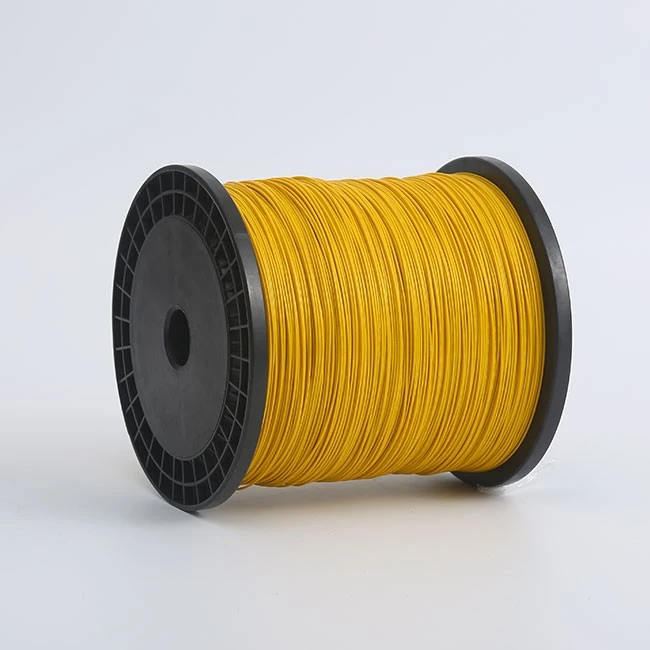
For high - voltage applications, our high voltage flexible cable is an ideal choice. It is designed to handle high - voltage signals with minimal impedance, reducing power losses and ensuring safe and efficient operation.
Contact Us for Purchasing
If you are in need of high - quality single core copper wire products, we are here to assist you. Our team of experts can help you select the right wire based on your specific impedance requirements and application needs. Whether you are working on a power transmission project, a communication system, or any other electrical application, we have the solutions for you.
We understand the importance of impedance in your projects, and we are committed to providing products with consistent and reliable impedance characteristics. Contact us today to start a discussion about your requirements and let us help you find the perfect single core copper wire for your application.
References
- Grob, Bernard. "Basic Electronics". McGraw - Hill Education.
- Nilsson, James W., and Susan A. Riedel. "Electric Circuits". Pearson.
- Hayt, William H., and Jack E. Kemmerly. "Engineering Circuit Analysis". McGraw - Hill Education.