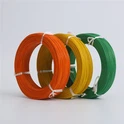
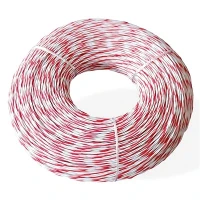
As a supplier of insulated wire, I often get asked about the resistance of insulated wire. Understanding the resistance of insulated wire is crucial for various applications, from electrical engineering to telecommunications. In this blog post, I'll delve into what the resistance of insulated wire is, its influencing factors, and its significance in different industries.
What is the Resistance of Insulated Wire?
Resistance in an electrical conductor, such as an insulated wire, is a measure of the opposition to the flow of electric current. It is quantified in ohms (Ω). When an electric potential difference (voltage) is applied across the ends of a wire, electrons start to move, creating an electric current. However, the atoms in the wire's material impede the free movement of these electrons, and this opposition to electron flow is what we refer to as resistance.
The formula for calculating the resistance (R) of a wire is given by Ohm's Law: (R = \frac{V}{I}), where (V) is the voltage across the wire and (I) is the current flowing through it. For a wire, the resistance can also be calculated using the formula (R=\rho\frac{L}{A}), where (\rho) is the resistivity of the wire material, (L) is the length of the wire, and (A) is the cross - sectional area of the wire.


Factors Affecting the Resistance of Insulated Wire
1. Material of the Conductive Core
The resistivity ((\rho)) of the material used for the conductive core of the insulated wire is a fundamental factor. Different materials have different resistivities. For example, copper is widely used in insulated wires because it has a relatively low resistivity ((\rho_{copper}=1.68\times10^{-8}\Omega\cdot m) at (20^{\circ}C)), which means it allows electric current to flow more easily compared to some other metals. Aluminum is also used, although its resistivity ((\rho_{aluminum}=2.65\times10^{-8}\Omega\cdot m) at (20^{\circ}C)) is higher than that of copper.
2. Length of the Wire
According to the formula (R = \rho\frac{L}{A}), the resistance of a wire is directly proportional to its length. As the length of the wire increases, the electrons have to travel a longer path, encountering more atoms along the way, which increases the overall resistance. For instance, if you double the length of a wire while keeping the cross - sectional area and material constant, the resistance will also double.
3. Cross - sectional Area of the Wire
The resistance of a wire is inversely proportional to its cross - sectional area. A larger cross - sectional area provides more space for the electrons to flow, reducing the likelihood of collisions with the atoms in the wire. So, a wire with a larger diameter will have lower resistance. If you double the cross - sectional area of a wire, the resistance will be halved, assuming the length and material remain the same.
4. Temperature
The resistivity of most conductive materials increases with an increase in temperature. As the temperature rises, the atoms in the wire vibrate more vigorously, which makes it more difficult for the electrons to flow through the wire, thus increasing the resistance. For example, in copper wires, the resistance can change by about 0.39% per degree Celsius change in temperature.
5. Insulation Material
Although the insulation itself does not conduct electricity (ideally), it can indirectly affect the resistance of the wire. Some insulation materials have good thermal conductivity, which can help dissipate heat generated in the wire due to current flow. This can prevent the wire from overheating and keep the resistance relatively stable. On the other hand, if the insulation has poor thermal properties, the wire may heat up more, leading to an increase in resistance.
Significance of Understanding Wire Resistance in Different Industries
1. Electrical Power Transmission
In power grids, the resistance of transmission lines is a critical factor. High - resistance wires would result in significant power losses in the form of heat ((P = I^{2}R), where (P) is the power loss). Therefore, low - resistance wires, usually made of copper or aluminum, are used in power transmission to minimize these losses. Moreover, for long - distance transmission, larger cross - sectional area wires are often employed to reduce resistance further.
2. Electronics
In electronic circuits, the resistance of wires can affect the performance of the components. For example, in a printed circuit board (PCB), the resistance of the traces (wires on the board) can cause a voltage drop, which may affect the proper functioning of integrated circuits. Designers need to carefully consider the wire resistance to ensure that the voltage supplied to each component is within the required range.
3. Telecommunications
In telecommunications, the resistance of the wires used in cables can impact signal quality. High - resistance wires can cause attenuation of the electrical signals, which means the signals weaken as they travel along the wire. This can lead to a loss of data or poor call quality. Therefore, low - resistance wires are essential for high - speed data transmission.
Our Insulated Wire Products and Resistance
As a supplier of insulated wire, we offer a wide range of products, including UL1371 FEP Insulated Wire and UL3340 Insulated Wire. These wires are carefully engineered to have optimal resistance properties based on their intended applications.
Our UL1371 FEP Insulated Wire is known for its excellent electrical insulation and low resistance. The FEP insulation material not only provides good protection for the conductive core but also helps in maintaining a stable resistance even under varying environmental conditions. This wire is suitable for applications where high - frequency signals need to be transmitted with minimal loss.
The UL3340 Insulated Wire, on the other hand, is designed with a tin - plated copper core and EPDM insulation. The tin plating on the copper core helps to reduce oxidation and maintain a low resistance over time. The EPDM insulation offers good mechanical and electrical properties, making this wire ideal for applications in harsh environments.
Conclusion
In conclusion, the resistance of insulated wire is a complex yet important concept that has far - reaching implications in various industries. By understanding the factors that affect wire resistance, engineers and designers can make informed decisions when selecting the right wires for their applications. As a supplier of insulated wire, we are committed to providing high - quality products with optimal resistance properties.
If you have any requirements or questions about our insulated wire products, we welcome you to contact us for procurement discussions. We are here to help you find the best solutions for your needs.
References
- Halliday, D., Resnick, R., & Walker, J. (2014). Fundamentals of Physics. Wiley.
- Serway, R. A., & Jewett, J. W. (2018). Physics for Scientists and Engineers. Cengage Learning.