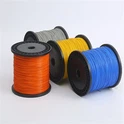
As a supplier of multi core copper wire, I have recently received many questions about the skin effect of multi-core copper wire. Today, based on our factory's years of practical experience in supporting high-end equipment, we will thoroughly understand the skin effect, talk about the unique advantages of multi-core copper wire in high-frequency environments, and share our experience in wire selection for high temperature and high-frequency harsh working conditions.
What is the skin effect?
The professional definitions in physics textbooks are obscure and difficult to understand, filled with formulas and professional terms, and still confused after reading them. Here I use an analogy that everyone can intuitively understand to easily break down this physical phenomenon.
We can imagine the conductive space inside the entire copper wire as a wide urban tunnel, where the current is the vehicles shuttling through the tunnel.
If the transmission is direct current or extremely low-frequency alternating current, the traffic environment is very friendly. All lanes inside the tunnel will be fully utilized, with vehicles evenly distributed in all areas from the center to the edges. The overall resistance of the wires is stable, and the conductivity value of copper materials can be maximized. That's also why in ordinary DC power supply scenarios, people don't have to worry about skin effect at all.
Once switched to high-frequency AC power mode, everything will change. The rapidly alternating current generates a dynamic magnetic field, which in turn generates eddy currents, creating an invisible barrier inside the tunnel. Due to the repulsion of this force, the current cannot flow smoothly through the central area of the wire and can only be forced to gather and flow in a thin circle on the surface of the wire.
This is what we often refer to as the skin effect. And there is a crucial characteristic: the higher the operating frequency, the stronger the repulsive effect of this invisible barrier, the thinner the conductive surface that the current can adhere to, and the more idle copper material inside the wire. Due to this characteristic, it almost only affects high-frequency AC power, and we can completely ignore its interference with DC circuits.


What hidden dangers can be buried by the inconspicuous skin effect?
Many small and medium-sized factories do not even consider skin effect when wiring, thinking it is just a small physical phenomenon that cannot stir up any waves. But based on the customer cases we have encountered, ignoring it for a long time and accumulating hidden costs over time is much higher than the price difference of choosing the right wire.
The most obvious change is a significant reduction in the actual conductivity of the cable. In high-frequency environments, a single core solid copper wire may appear to have sufficient nominal cross-sectional area, but in reality, most of the internal areas are unable to conduct current, resulting in a cliff like drop in effective conductive area. As the conductive area decreases, the resistance naturally increases, and the wires that were originally adapted to the equipment will instantly experience insufficient power supply and load non-compliance.
After the resistance increases, heating problems will also follow one after another. I believe everyone understands the underlying logic of Joule's law, which states that most electrical energy loss is converted into thermal energy. Under long-term high-temperature operation, the surface temperature of the cable remains high, and the insulation layer made of ordinary PVC and PE materials cannot withstand it at all. I have seen many customers' devices with problems such as yellowing, cracking, melting, and adhesion of the wire outer skin after only about half a year of operation. This not only requires frequent replacement of wires to increase maintenance costs, but also greatly increases the safety risks of short circuits and leakage.
If applied in scenarios such as precision medical instruments and RF communication equipment that are highly sensitive to signals, the negative impact of skin effect will be infinitely amplified. Unstable resistance and continuous temperature fluctuations can directly cause signal attenuation and waveform distortion, ranging from signal delay and transmission lag to instrument errors and equipment shutdown, directly affecting the normal operation of the entire production line.
How to resolve the skin effect? Multi core twisted wire is the optimal solution
Since high-frequency working conditions cannot completely eliminate the skin effect, how can we avoid its negative impact? In the electrical wiring industry, engineers have already formed a unified consensus: abandon large square single core copper wire and switch to multi-core stranded wire made by twisting multiple strands of thin copper wire.
Let me explain the principle to everyone in a straightforward manner. Taking a 10mm ² specification cable as an example, a whole solid single core copper wire has a large area of unused internal copper material in high-frequency environments; But if we break down this copper wire into hundreds of ultra-fine copper wires around 0.2mm, and then twist them together through professional processes, the situation will be completely reversed.
As mentioned earlier, the effective conductive thickness of current at high frequencies is limited, and the diameter of the thin copper wire we split just fits the skin depth corresponding to this working condition. Simply put, every thin copper wire can achieve full conductivity without any internal idle issues, and all copper materials can maximize their conductivity.
In addition, multi-core cables produced by legitimate manufacturers will use staggered twisting technology. During the operation of the cable, the inner and outer copper wires will constantly switch positions, allowing all copper wires to evenly distribute current and heat. This design not only effectively reduces overall resistance and energy loss, but also disperses heat, alleviating the problem of local overheating from the root.
By comparing in this way, everyone can clearly see the gap. Under high-frequency working conditions, the conductivity efficiency and heat dissipation capacity of multi-core stranded wires can comprehensively crush single core wires of the same specifications; Even in low-frequency ordinary scenarios, multi-core wires are more suitable for complex wiring environments such as inside computer cases and small device cavities due to their soft and easily bendable characteristics.
High temperature, high frequency and harsh environment, ordinary multi-core wires are far from enough
Choosing multi-core copper wire can indeed perfectly solve various wiring problems caused by skin effect, but it is only suitable for ordinary indoor, room temperature, and non corrosive working conditions. If your equipment is exposed to harsh production environments such as high temperature, strong corrosion, heavy oil pollution, and large temperature differences between day and night for a long time, ordinary multi-core copper wires will still frequently experience aging and damage problems.
We have been deeply involved in the wire and cable industry for many years. Zhejiang IRONFLON has served numerous customers in the fields of new energy, aerospace, precision medicine, and high-frequency heating equipment. Based on our extensive experience in project support, I recommend that customers in high-end working conditions prefer to use specialized wires with multi stranded copper wire and fluoroplastic insulation.
At the conductor level, our fluoroplastic wire is made entirely of high-purity oxygen free copper multi stranded, and some special working conditions can be treated with tin plating. It can perfectly adapt to high-frequency working environments, weaken skin effect, reduce heat loss, and the tin plating process can greatly improve the copper wire's ability to resist oxidation and acid alkali corrosion, making it easy to cope with production scenarios such as chemical humidity and heavy oil pollution.
The insulation layer is made of high-quality fluoroplastic materials such as FEP and PTFE, which are currently recognized as high-quality insulation materials in the high-end cable field. Compared with the common PVC insulation materials on the market, it has a wider temperature range, can be stable in the environment of -60 ℃ to 260 ℃ for long-term operation, and has high temperature resistance and aging resistance. Even if it is in a high temperature and high frequency state for a long time, the outer skin will not deform, crack, or age; At the same time, the thickness of the insulation layer is thinner and lighter, which further upgrades the overall flexibility of the cable, and there is no pressure on bending and wiring in narrow spaces.
In fact, at the end of the day, the skin effect is not a profound and obscure professional knowledge, but a basic physical phenomenon that is easily overlooked by everyone. But often it is these inconspicuous details that quietly increase equipment energy consumption, shorten wire service life, and even bury safety production hazards.
If you are worried about cable selection, unsure of which wire diameter and material products are suitable for equipment conditions, or have a need for customized fluoroplastic insulated wires, feel free to contact us at any time. We have our own production factory and support personalized customization of full specification cables. At the same time, we provide free professional technical selection guidance to help everyone solve all wiring problems in one stop.