As a supplier of UL1886 tinned FEP insulated wire, I will now share all the information about its specifications with my friends based on my own experience.
Let me clarify a common misconception. Many people think UL1886 tinned FEP insulated wire is a model of a certain wire, but in fact, it is a special standard developed by UL for "tinned conductor+FEP insulation" wires. The core is to adapt to high temperature, highly corrosive, and high safety requirements scenarios. The specifications of this wire are not a single number, but need to be comprehensively considered from the aspects of conductor, insulation layer, and electrical performance. Each item directly affects the actual use effect and cannot be taken lightly.
Let's talk about conductors first. They are the "core skeleton" of wires, carrying the key role of current transmission. The UL1886 standard explicitly requires that conductors must be tin plated copper wire. Many customers may ask why tin plating is necessary? It's actually quite simple. A customer who used tin free copper wire for chemical equipment wiring experienced oxidation and blackening in less than three months, and it was prone to virtual soldering during welding, resulting in particularly high maintenance costs in the later stages. The tin plating layer can perfectly solve this problem, preventing copper wire oxidation and improving welding performance, especially in high-frequency welding scenarios, where the advantages are particularly obvious. There are mainly two types of conductor structures: solid and twisted. When I recommend them to customers, I usually choose according to their wiring scenarios. If it is a connection that needs frequent bending inside the equipment, such as the wiring in medical equipment, I will recommend twisted conductors. The common 7-strand and 19 strand twisted conductors are suitable, with good flexibility and not easy to break; If the wiring is fixed inside the device and does not require movement, solid conductors are sufficient, with stronger stability and higher cost-effectiveness.
In terms of wire diameter, UL1886 commonly uses 30-10AWG. Here are a few commonly used in practical cases. For example, customers who make small electronic sensors often use 30AWG, mostly solid conductors of 1/0.254 mm, which are just suitable for the compact space of small devices; Customers who make industrial control boxes use the most 22AWG, mostly 19/0.15 mm stranded conductors, which can balance current carrying capacity and flexibility; Customers who specialize in large power equipment will also use 10AWG, 19/0.60 mm twisted conductors to meet their high current transmission needs. Here is a reminder that it is not the thicker the wire diameter, the better. Matching the current demand of one's own equipment is the key, otherwise it will only increase costs and waste space.
Let's talk about the insulation layer that everyone is most concerned about. The core advantage of UL1886 is here --- FEP insulation layer. Some people may confuse FEP and PTFE. In fact, both are fluoroplastics, but FEP can be melted and processed, making it more suitable for mass production of wires. Its insulation performance is also more in line with industrial requirements. In terms of temperature resistance, based on my actual testing and customer feedback, UL1886's long-term operating temperature can indeed reach 150℃, and its short-term peak temperature can reach around 180℃. In extreme low temperature environments, it can withstand a minimum of -60℃, which is sufficient to adapt to the vast majority of industrial outdoor scenes, such as equipment wiring in the northern winter season, and can also operate stably.
There are also requirements for insulation thickness. The minimum thickness for conventional insulation should not be less than 0.21mm, and the average thickness should not be less than 0.26mm. Previously, a customer purchased a product with insulation thickness that did not meet the standard, but insulation breakdown occurred during operation, resulting in equipment short circuit and significant losses. In addition, the environmental and flame retardant properties of FEP insulation layer are also important. It complies with ROHS and REACH environmental standards, has no heavy metals or harmful plasticizers, and is suitable for electronic devices with high environmental requirements; At the same time, it has passed UL VW-1 and CSA FT1 flame retardant tests, with less smoke during combustion and the ability to self extinguish. It is more reassuring to use in high fire protection scenarios such as electronic factories and computer rooms. Moreover, FEP material has extremely strong chemical stability. It has been recommended to customers in the chemical industry before and has been used in acidic, alkaline, solvent, and oil environments for more than two years without any corrosion or aging of the insulation layer.


Electrical performance is the bottom line for safe operation, and this part cannot be ambiguous. The standard rated voltage is 300V, and customers with special requirements can also find specifications between 300V-600V. For example, customers who make high-voltage control equipment need to choose the 600V specification to avoid overload. The withstand voltage strength is 2500VAC/1min, which is a mandatory requirement of UL1886. It can effectively prevent voltage breakdown and reduce the hidden dangers of short circuit and leakage.
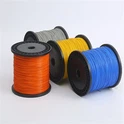
Finally, let's talk about mechanical performance and packaging. Although these details may not be eye-catching, they affect the actual user experience. In terms of mechanical performance, the tensile strength and elongation at break of this wire meet UL standards. When wiring, occasional pulling and bending will not break. Previously, a customer accidentally pulled and bent the wire during equipment assembly, thinking it would break. However, after inspection, it was found that there was no problem at all, and the flexibility was indeed good. In terms of color, common colors include white, blue, red, black, and brown. When wiring, it can be distinguished according to the function of the circuit, such as using red for power lines and blue for signal lines, which can greatly improve construction efficiency and reduce the probability of misconnection.
The packaging specifications are also very thoughtful. The fine wire diameter (30-18AWG) is mostly 2000FT (about 610 meters/roll), and the thick wire diameter (17-10AWG) is 1000FT (about 305 meters/roll). Customers can choose according to their own usage to avoid waste.
To summarize, when selecting UL1886 tinned FEP insulated wire, it is best to choose according to your actual scenario: focus on temperature resistance performance in high temperature environments, choose thick wire diameter in high current scenarios, confirm the stability of FEP insulation in corrosive environments, and pay attention to resistance and dielectric properties in high-frequency signal transmission. Over the years, I have helped many clients choose the right specifications and have seen many cases of pitfalls due to selection errors. I hope that the practical experience shared today can help everyone avoid detours.
If you are still unsure which specifications are suitable for your scenario, such as not knowing what wire diameter and rated voltage to choose for your equipment, feel free to leave a message to share your usage scenario and requirements. I can help you accurately match and avoid procurement errors.