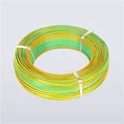
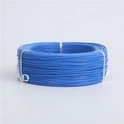
Whether it is precision instruments in aerospace, core circuits in new energy vehicles, or corrosion-resistant equipment in chemical workshops, they all rely on an insulated wire that cannot be found to be faulty - Teflon Insulated wire cable. Why is Teflon wire and cable the preferred choice for high-end scenarios? The answer is simple: it can solve the problem of other wires being unable to withstand it, and it can still output stably in extreme environments. This is also the core reason why we have been focusing on the research and production of this product.
Don't be scared by its "high cold": step into the world of Teflon wire and cable
When choosing cables, people may often hear the word 'Teflon'. In the impression of many people, it is the non stick coating on the pot. But in the wire industry, Teflon (usually referring to PTFE, FEP, or PFA) is simply the "superhero" of the insulation industry.
Why do you say that? Because it is almost an 'all-around player':
- Even dancing by the fire is not afraid: its high temperature resistance is extremely strong.
- Even swimming in acidic or alkaline solutions doesn't matter: it has excellent chemical stability.
- Even under high-frequency current, it can maintain alertness: the insulation performance is stable enough to make people feel at ease.
So, if you are developing drones, high-end medical equipment, or precision robots in automated factories, ordinary PVC or silicone wires may have already "gone on strike". At this point, Teflon wires are your lifeline.


Why does your project have to consider Teflon Insulated Wire cable?
In the international market, many customers initially choose cheaper alternatives to save money. But in the end, they often come back to us and say, 'We still need to replace the Teflon, the previous wire burned/melted/the signal was unstable.' Let's take a look at what makes Teflon strong:
1. It is a true 'heat-resistant expert'
The temperature tolerance range of Teflon wire is usually between -65 ° C and+200 ° C (some can even reach+260 ° C).
What does this mean?
- In the harsh Nordic outdoor monitoring system, it will not freeze and become brittle.
- In industrial laser equipment with huge heat generation, it will not cause short circuits due to overheating.
2. Master of Space Management
The electrical insulation performance of Teflon is very good, which means we can achieve the same withstand voltage effect with a thinner insulation layer.
This is simply a blessing for products that pursue lightweight and miniaturization, such as aerospace and portable electronic products. The wires have become thinner, making it more convenient to bundle them and freeing up more internal space for heat dissipation.
3. It can resist any "temptation"
Whether it's engine oil, gasoline, or strong acids and bases, Teflon is almost immune. For work environments with heavy oil pollution and strong chemical corrosion in industrial sites, Teflon wire and cable is the "hard bone" that can accompany you until the end.
Revealing: How does Chinese manufacturing achieve "good quality and low price"?
Many foreign clients ask during consultations, "Why are your prices so competitive? Can you guarantee the quality
In fact, this is not because we cut corners, but because China's supply chain has formed an "ecological synergy effect".
The popularization of automated production
The current cable factories in China are no longer the crowded handmade workshops of the past. We have introduced advanced extruders and online detection systems. From wire drawing and twisting to the final extrusion of Teflon coating, the entire process is digitally monitored. This not only reduces manual errors but also significantly improves production efficiency.
Maturity of raw material supply chain
China is a major chemical country, and although top-level Teflon resin is still the industry benchmark, our domestic chemical giants are also catching up quickly. We can flexibly choose imported or domestically produced high-performance materials according to customer needs, in order to find the most perfect "balance point" between performance and cost.
Flexible customization capability
If common models on the market cannot meet your production requirements, Chinese suppliers are usually willing to work with you on research and development. This kind of response speed and flexible production is difficult to imagine in many countries.


How to choose Teflon wires like a professional?
Since everyone wants to buy good goods, I will share a few "down-to-earth" methods commonly used in production sites to distinguish between good and bad.
Check if the surface is smooth
The surface of high-quality Teflon wire should be round, smooth, and free of impurities. Due to the extremely low friction coefficient of Teflon material itself, if the wire feels rough or has a noticeable particle feel, it indicates that there is a problem with the extrusion process or impurities have been added to the raw material.
Measurement: Concentricity of insulation layer and core wire
This is the place that tests the factory's level the most. You can cut the wire and see if the copper core is exactly at the center of the circle. If it is biased (we call it "biased core"), then in long-term use, the thin side is easily punctured, causing safety risks.
Burning: True gold fears no fire
Teflon is a non combustible material. You can try using a lighter to burn it. True Teflon does not ignite, only shrinks slightly, and has no pungent plastic odor. If it burns immediately, it is definitely a counterfeit.
Common question: Which should I choose PTFE, FEP, PFA?
Don't be confused by these abbreviations, although they are all called Teflon, their personalities are still a bit different:
- PTFE (polytetrafluoroethylene): It has the highest temperature resistance (up to 260 ° C), but it cannot be "melted and extruded" like ordinary plastics, and can only be pressed using a pushing process. It has a relatively soft feel and the strongest chemical resistance.
- FEP (perfluoroethylene propylene): This is the cost-effective choice. It can be melted and extruded, with high production efficiency. Resistant to temperatures around 200 ° C, with good transparency and toughness, it is very suitable for making long-distance cables.
- PFA (perfluoroalkyl): Combining the advantages of the previous two, it can be processed at high temperatures, has temperature resistance, and is close to PTFE. If you have extremely high requirements for the bending resistance and high-temperature life of the wire, choosing it is definitely the right choice.


Regarding Trust and Win Win
Distance and language are often the biggest obstacles in global trade. As a Chinese supplier, we deeply understand that integrity is more important than gold.
When you place an order to purchase a Teflon Insulated Wire cable, you are not only buying a few axis wires, but also the safety guarantee of your entire project. We will conduct strict withstand voltage testing, aging testing, and conductivity testing before shipment, and provide you with detailed inspection reports.
If you are looking for a long-term partner who understands technology, communication, and can provide reasonable prices, why not start with a simple sample first?
What would you like to know next?
- Do you want a comparison chart of different specifications of Teflon wire and cable?
- Do you need us to send free samples for testing your current engineering project?
- Or would you like to directly consult cable selection for a certain special environment?
Contact us anytime(luna@ironflon.com), we are not only your supplier, but also your technical support!