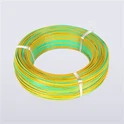
Why is Teflon wire cable a "must-have" for new energy vehicles?
In new energy vehicles, cables are like "neural networks+energy vessels", transmitting complex signals and high-voltage electrical energy. And Teflon wire cable stand out from it thanks to their ability to "build". Let's first think about how harsh the working environment of new energy vehicles is: the temperature fluctuates dramatically during battery charging and discharging, the temperature inside the car skyrockets after being exposed to sunlight in summer, and the low temperature in winter makes many materials brittle; There may also be electrolyte leakage in the battery compartment, and the cables of the chassis must withstand vibration and mud erosion. The insulation performance of the high-voltage system cannot be taken lightly.
Traditional cables are prone to "chain failure" in these scenarios, such as ordinary PVC insulated cables with low temperature resistance limits, which soften and deform at high temperatures, and are prone to cracking at low temperatures. But Teflon (scientific name polytetrafluoroethylene) material is naturally not afraid of these: it has super high temperature resistance, can work stably even at temperatures of 200 degrees Celsius, and will not become brittle in winter even at temperatures below minus tens of degrees Celsius; Chemical stability is unparalleled, and corrosive substances such as battery fluid and oil stains cannot harm it at all. More importantly, its insulation performance can firmly hold the safety line in the high-voltage environment commonly used in new energy vehicles, without the risk of leakage. For new energy vehicles that pursue safety and durability, Teflon insulated wire cable have naturally become an indispensable choice.


It can't be used without resistance! The "entry threshold" for Teflon automotive cable
To enter the "door" of new energy vehicles, Teflon insulated wire cable must pass through a series of standard checkpoints. These standards are like "quality manuals", ensuring that each cable meets safety and usage requirements, mainly divided into three categories: national standards, industry standards, and car manufacturers' own "customized standards".
Firstly, the national standard is the foundation, which is the most basic 'red line'. For example, the GB/T 37133 standard specifically targets high-voltage wiring harnesses for new energy vehicles, with clear requirements for the salt spray resistance and vibration stability of New energy automotive cable. For example, the salt spray test must withstand 48 hours, and even in humid and salty environments by the sea, it will not rust; The signal interruption time during random vibration should not exceed 1 microsecond to avoid signal disorder during vehicle operation. There is also the industry standard QC/T 1037, which adds a "safety lock" to high-voltage cables, requiring them to withstand high-voltage testing for 1 minute without breakdown under specific voltages. For example, for commonly used high-voltage systems, they must be able to withstand voltage surges of 8kV or even 10kV.
Next is the refinement of row labels to address the "special needs" of different scenarios. For example, the IEC 62153 series standard focuses on electromagnetic compatibility, as there are too many electronic devices in new energy vehicles. If the anti-interference ability of cables is poor, it will affect the normal operation of navigation, radar and other systems. This standard requires that the shielding layer coverage of New energy automotive wire cable reach at least 85%, which can effectively block electromagnetic signal interference.
Finally, there is the "customization plus" of car companies. Different car companies have different vehicle designs and battery layouts, and their requirements for cables will also be more specific. For example, some car companies use 800V high-voltage platforms, which require cables to withstand greater currents while controlling temperature rise; Some car companies focus on optimizing the interior space and require cables to be thinner and more flexible for easy wiring in narrow spaces. BYD's e-platform and Tesla's high-voltage system both have their own set of acceptance criteria, and only those that match perfectly can be selected.


Details determine success or failure! Technical Training Manual for Teflon Wire Cable
If the standard is the "passing line", then the technical requirement is the "excellent line". A qualified Teflon insulated wire cable for a new energy vehicle requires careful consideration of every detail, from materials to structure to craftsmanship, with a focus on three core dimensions.
The first dimension is material selection, which is the foundation. Teflon insulation layer cannot be made of ordinary materials casually. High purity polytetrafluoroethylene must be selected, and some even add fluorinated ethylene propylene copolymer to enhance wear resistance and flexibility. The conductor part also has its own requirements. It is not enough to use a single thick copper wire, but to use multiple strands of thin copper wire combined and twisted. For example, some designs have nineteen sets of wire cores, each containing seven strands of thin conductor. This can improve flexibility, facilitate bending and wiring, and reduce heat generation when current passes through. Moreover, the diameter of each conductor core and the thickness of the insulation layer are strictly controlled. For example, the outer diameter error of the insulation layer cannot exceed 0.15 millimeters, and the concentricity must be greater than 70%, otherwise it will affect the insulation effect.
The second dimension is structural design, which should balance "performance and practicality". New energy automotive cable not only need strong performance, but also need to adapt to the complex installation environment inside the car. For example, bending performance is crucial. For frequently moving parts such as car doors and chassis, cables must be able to withstand millions of bends without breaking. Nowadays, good Teflon insulated wire cable in the industry can meet the requirement of a bending life of 10 million times. There is also a shielding structure, which usually adopts a multi-layer shielding design. In addition to Teflon insulation layer, metal woven mesh is also added to prevent electromagnetic interference and enhance mechanical strength, avoiding being scratched by sharp parts.
The third dimension is process control, which is' quality assurance '. For example, in the extrusion molding of the insulation layer, temperature control must be precise to the millimeter. If the temperature is too high, Teflon will decompose and deteriorate, while if the temperature is too low, the insulation layer will be uneven, resulting in bubbles or cracks. There are also techniques for conductor twisting, using a combination twisting process to make each copper wire arranged more compactly. This not only makes the appearance more round, but also improves the adhesion with the insulation layer, avoiding loosening during use. After production is completed, each batch of cables also needs to undergo a "full body physical examination", such as using specialized equipment to check for pinholes in the insulation layer, and checking the anti fracture ability through tensile testing. Only when all indicators meet the standards can they be packaged and sent to the production workshop of the car company.


More than just 'usable', the future direction of Teflon wire cable
With the development of new energy vehicles towards high range, fast charging, and intelligence, Teflon insulated wire cable are also upgrading and playing tricks. Nowadays, car companies not only require cables to be "carried", but also hope that they can be "lighter" - after all, if the body weight is reduced a little, the range can be extended by a few kilometers. So the industry began to develop thin-walled Teflon insulation layers, reducing the thickness while ensuring insulation performance, and replacing some copper conductors with lighter alloy conductors, which not only reduces weight but also does not affect conductivity.
Intelligence has also brought new requirements to New energy automotive cable, such as the need for a large number of sensors to transmit data for autonomous driving. Cables not only need to be anti-interference, but also able to support higher transmission rates to avoid data delays affecting decision-making. In addition, recycling is also a new trend. Currently, some companies are developing recyclable Teflon materials to enable environmentally friendly disposal of scrapped cables, which is in line with the green concept of new energy vehicles. It can be said that the development of Teflon insulated wire cable has always followed the footsteps of new energy vehicles, serving as both an "old partner" and a "new comrade".
If you still want to delve deeper into the technical details of New Energy Automotive wire Cable, or want to learn about cable adaptation solutions for different vehicle models, feel free to contact our professionals at any time( luna@ironflon.com ). Whether it's industry inquiries, technical consultations, or demand matching, we will respond promptly and help you clarify the issues.