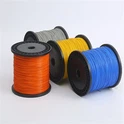
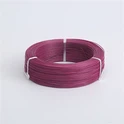
Railway signal systems are the nervous system of the railway network, ensuring the safety and efficiency of train operations. The choice of wiring in these systems is critical, as it directly impacts the reliability and performance of the signals. As a PFA insulated wire supplier, I am often asked whether PFA wire can be used in railway signal systems. In this blog, I will explore this question in detail.
PFA insulated wires can be used in railway signal systems, and in high demand scenarios such as railway signals, PFA insulated wires are actually more durable than ordinary cables. But it doesn't mean that just a roll of PFA wire can be installed on railway projects. After all, the environment along the railway is much more complex than the factories and interiors we encounter in our daily lives. We need to choose the right specifications and standards in order to use them safely.
Many people may not have the concept that railway signal systems are far more demanding of cables than ordinary industrial scenarios. Wind and sun exposure are commonplace, with temperatures as low as minus tens of degrees in winter, high temperatures after exposure to the sun in summer, persistent moisture in tunnels throughout the year, lingering salt spray along coastal roads, and strong electromagnetic interference inherent in electrified railways. Any of these factors can cause ordinary PVC and PE insulation lines to "retire" early, either cracking and aging, or signal distortion during transmission, which can affect train punctuality or safety. The reason why PFA insulated wires can adapt to this scenario is the inherent hardness advantage of their material.
Take temperature resistance as an example. The ordinary cables we usually come into contact with have a soft outer layer after being exposed to sunlight for a long time in summer, and crack easily after being frozen through and bent in winter. If the temperature exceeds the standard slightly, it is easy to cause hidden dangers. PFA insulated wires do not have this problem at all. The regular working temperature can cover -80 ℃ to 260 ℃, and the extreme short-term high temperature can withstand up to 300 ℃ without failure. Whether it is construction on high-altitude roads, or long-term exposure to sunlight, even if buried underground or in tunnel pipe galleries, the insulation layer is always stable, will not deform or crack, reducing the trouble of later operation and maintenance.
Speaking of signal transmission, it is the lifeline of railway signaling. Usually, taking high-speed trains can feel the train running smoothly and stopping accurately, relying on zero error transmission of signal commands. However, the contact network and surrounding electrical equipment of electrified railways can generate electromagnetic interference, and ordinary cables are easily affected, resulting in signal crosstalk and distortion. The insulation performance of PFA material itself is top-notch, with stable dielectric constant and natural ability to block external electromagnetic interference. It is like adding a stable "protective shield" to signal transmission, without the need for additional complex shielding treatment, which can ensure clear and non jamming signals. Even in strong interference electrified sections, the transmission of train control and interlocking signals is stable.
There are also corrosion resistance and flexibility that are easily overlooked in daily life. Railway cable laying scenes are too diverse, some need to be buried underground, some need to pass through narrow conduits, and some need to be exposed to corrosive gases in coastal salt spray and chemical road sections. Ordinary cables can be corroded and severely worn out within a year or two. PFA insulated wires can withstand various forms of corrosion such as acid, alkali, salt spray, and oil stains, with a smooth surface and low friction. When laying, it is not difficult to pass through pipes, and it will not become hard or brittle in low temperature environments. It will not break even if bent casually. Whether it is complex wiring in stations or construction in narrow spaces in tunnels, it can be easily adapted without delaying the construction period due to stiff cables.


To be honest with everyone, not all PFA insulated wires on the market can be used in railway signal systems. This is also the bottom line for us as a reliable supplier, and we cannot step on these two key points. Firstly, it is necessary to adhere to industry standards. The railway industry has exclusive technical specifications, unlike ordinary industrial lines that can be easily made. For example, ordinary railway signals and high-speed train control systems have corresponding TB industry standards, with clear thresholds for conductor specifications, insulation thickness, flame retardancy, low smoke and non-toxic requirements. Our PFA insulated wires from Zhejiang IRONFLON are produced in accordance with railway specific standards throughout the entire process, and have also passed UL related international safety certifications. The flame retardant level meets the standard, and there will be no toxic smoke when burned, fully meeting the safety and environmental protection requirements of railway operations. The parameters accurately match the usage needs of the signal system, and there will be no compatibility issues with specifications.
Furthermore, it is necessary to customize according to the scene. The demand for different road sections varies greatly, and for sections with strong electrical interference, a suitable shielding layer needs to be added; Cables buried directly underground need to be armored to prevent compression and rodent bites; In areas with heavy salt spray along the coast, it is necessary to optimize the sheathing process and strengthen anti-corrosion measures. We never recommend generic products to customers. Instead, we first clarify the construction route, laying method, and signal equipment type, and then customize the corresponding cables to make the product just suitable for the scene, without wasting money or posing safety hazards.
I once encountered a customer of a coastal railway who used ordinary cables and had to replace them in large quantities every year. The salt spray corrosion was too severe, and signal failures occurred frequently, causing the operation and maintenance personnel to break their legs and resulting in high costs. Later, it was replaced with our customized PFA insulated wire. For more than three years, there has not been a single insulation damage or signal interruption, and the operation and maintenance costs have been directly reduced by half. The customer later specified this wire for their new project.
Going back to the original question, can PFA insulated wire be used in railway signal systems? The answer is clear: yes, and it is the preferred choice for high demand scenarios. It is temperature resistant, signal stable, and has a long corrosion resistance life, which perfectly meets all the core requirements of railway signal systems. As long as the products that meet the standards and adapt to the scene are selected correctly, it can ensure the safety of train operation and save a lot of maintenance costs in the later stage.
We at Zhejiang IRONFLON have been producing wires and cables for a long time, and have always focused on high-quality fluoroplastic insulated cables. From raw material screening to production quality inspection, every step is strictly controlled in order to provide reliable products for harsh scenarios such as railways and industrial control. Whether it's a conventional railway station yard, a high-speed train control system, or special sections such as tunnels, coastal areas, or high-altitude areas, whether you're unsure of what specifications to choose or want to customize an adaptation plan, you can communicate anytime. We can discuss with you based on actual scenarios and help you choose the most suitable wires and cables.