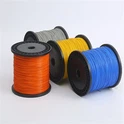
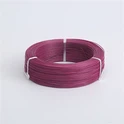
Connecting PFA insulated wire to other components is a crucial process in various electrical and electronic applications. As a reputable PFA wire supplier, we understand the importance of providing clear guidance on this topic. In this blog, we will delve into the detailed steps and considerations for successfully connecting PFA wire to other components.
Welding method: the most commonly used and applicable in most industrial scenarios
This is the method I usually recommend the most to customers, whether it's connecting terminals, sensors, or small electrical components, using it is reliable. Not only is the connection firm, but the conductivity is also stable. The only thing to pay attention to is the temperature. After all, PFA insulation layer is afraid of high temperatures. Just be careful not to burn the insulation layer.
The tools don't need to be too complicated, just the ones we commonly use for work: our UL10362 and UL1930 nickel plated PFA insulated wires (these two wires are the easiest to solder together and the wire cores are not easily oxidized), adjustable temperature soldering iron, lead-free soldering, soldering flux, and wire stripping pliers. Don't use ordinary scissors to strip the wire. I have seen several beginners try to use scissors to save time, but the wire cores are cut unevenly, which can easily cause heating and breakage when powered on later on. It's a pity.
It's also easy to operate. First, strip the wire and use wire strippers to remove the PFA insulation layer. The length should be controlled between 1/4 to 1/2 inch, which is about 6 to 13 millimeters. Be careful not to cut the wire core here. After peeling the wire, I will gently stroke the wire core with my hand to confirm that there are no scratches before proceeding to the next step.
Next is cleaning the wire core, don't skip this step. Gently polish the exposed wire core with fine sandpaper or wire brush, and wipe off the surface oxide layer and dust. Many people have poor contact after connecting, mostly because this step was not done properly. There is an oxide layer on the surface of the wire core, and the solder cannot stick firmly, forming a "false solder". The problem will occur soon.
Next, apply soldering flux without applying too much, just a thin layer is enough. Its function is like adding a layer of protection to the connection, allowing the solder to flow better and preventing the wire core from oxidizing again during soldering, especially in humid environments. This step can greatly improve the stability of the connection.
When welding, adjust the temperature of the soldering iron to 350 to 400 ℃, which can easily melt the solder without damaging the PFA insulation layer. First, heat the wire core with an electric soldering iron for a few seconds. When the wire core is fully heated, then touch the solder to the area where the wire core and soldering iron come into contact, allowing the solder to evenly wrap around the wire core and form a smooth and shiny solder joint. Don't pile up too much solder, otherwise it's easy to short circuit and the losses outweigh the gains.
Don't rush to touch after welding, wait for the solder joints to cool naturally. Touching them by hand may not only burn them, but also damage the solder joints. If used in a humid and corrosive environment, such as a chemical workshop, it is recommended to use heat shrink tubing to heat shrink, which can not only protect the solder joints from corrosion, but also further enhance the insulation effect and extend the service life.
There is another small detail to remind everyone, do not let the soldering iron touch the PFA insulation layer for a long time during welding, and move it away within 1 to 2 seconds at most. Our PFA insulation layer has strong toughness, but it cannot withstand high temperatures and prolonged baking. Once it melts and deforms, the insulation effect will be greatly reduced, making maintenance more difficult in the later stage.


Crimping method: First choice for beginners, worry free and efficient
If you are afraid of using a soldering iron and cannot control the temperature well, you can try crimping. I have seen many beginners who can successfully connect PFA insulated wires with crimping method for the first time. The operation is simple and efficient, and there is no need to master complex skills. It is suitable for batch wiring, such as batch operation in production lines and distribution boxes, which saves time and effort, and the connection firmness is not inferior to welding.
The tools are also very simple, including PFA wire, cold pressed terminals with suitable wire diameter, specialized wire crimping pliers, and wire stripping pliers. Attention should be paid here that the cold pressed terminals must be selected to match the specifications of the wire core. If an inappropriate terminal is used, it will loosen with a gentle pull after pressing, which can easily lead to problems in the later stage; It is also best to use specialized crimping pliers. Ordinary pliers do not have enough pressure, cannot press firmly, and cannot achieve the desired effect.
Wire stripping is the same as welding, stripping off the PFA insulation layer of 6 to 13 millimeters to ensure that the wire core is not damaged, and do not leave too long exposed wire core, otherwise it is prone to oxidation and short circuit.
Then fully insert the stripped wire core into the wiring hole of the cold pressed terminal, making sure it is fully inserted to ensure that the wire core is not exposed. Exposed wire cores are prone to oxidation and may even cause short circuits, which is the most easily overlooked detail for beginners. At the same time, be careful not to let the PFA insulation layer enter the crimping area of the terminal, otherwise it will not be tightly pressed and affect the connection effect.
Finally, align the crimping pliers with the crimping part of the terminal and press firmly. It is recommended to press twice to ensure that the terminal and wire core are tightly fitted and not loose. After crimping, you can gently pull the wire. If the wire core is not loose, it means the crimping is successful.
Let me share a little trick with you. Before crimping, you can apply a little conductive paste on the inner wall of the terminal. Especially in high temperature and humid environments, it can reduce core oxidation, make the conductivity more stable, and extend the service life of the joint.
Terminal block connection method: safe and easy to maintain in high voltage and high current scenarios
If it is connected in a distribution box or large equipment and needs to withstand high voltage and high current, the terminal block connection method should be used. Not only is the connection firm, but it is also convenient for later maintenance and replacement. There is no need to dismantle a pile of wires, which saves time and effort.
The preparation of tools is also not complicated, including PFA insulated wires, terminal blocks, screwdrivers (both straight and cross can be selected according to the type of terminal block screws), wire strippers, and if conditions permit, a multimeter can be prepared for easier inspection of conductivity in the later stage.
When stripping the wire, there is no need to precisely control the length like welding method. The standard is that the wire core can be completely inserted into the wiring hole of the terminal block and can be tightened by screws, usually 8 to 10 millimeters is enough. If it is a multi stranded wire core, remember to tighten it first and do not insert loose strands. Loose strands of wire core are prone to not being tightly compressed and may result in poor contact in the later stage.
Next, loosen the screws on the terminal block and insert the processed wire core into the wiring hole. Be careful not to let the insulation layer be pressed down by the screws. Pressing down may not only cause poor contact, but also damage the insulation layer, especially in high-voltage scenarios, which can pose a safety hazard. You can use tweezers to gently adjust the position of the wire core first, ensuring that the insulation layer is just outside the wiring hole and not touched by screws.
After tightening the screw, gently pull the wire to confirm that it is not loose. If there is a multimeter, check the conductivity again to ensure that there is no poor contact. Especially in high-pressure scenarios, this step must be taken to avoid trouble and effectively prevent safety accidents in the later stages.
If it is in special scenarios of corrosion and high temperature, such as semiconductor equipment and petrochemical reactors, it is recommended to choose anti-corrosion and high temperature resistant terminal blocks, which can be used in combination with our PFA insulated wire to maximize the advantages of the product and reduce maintenance costs in the later stage.
If you have any questions during the connection process, such as which method to choose for different scenarios or what specifications of terminals to match, feel free to consult us at any time. Our technical team has many years of practical experience and can provide one-on-one guidance to help solve connection problems in one go, without the need for repeated rework, saving time and costs.