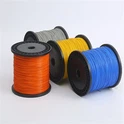
In the realm of electrical engineering, the choice of wire insulation is crucial, especially when dealing with high - frequency applications. As a supplier of PTFE insulated wire, I'm often asked whether PTFE insulated wire is suitable for high - frequency applications. In this blog post, we will delve into the properties of PTFE insulated wire and analyze its viability in high - frequency scenarios.
Properties of PTFE Insulation
PTFE, or polytetrafluoroethylene, is a well - known synthetic fluoropolymer. It has several unique properties that make it stand out in the field of wire insulation.
One of the most remarkable features of PTFE is its low dielectric constant. The dielectric constant is a measure of how much an insulating material can store electrical energy in an electric field. In high - frequency applications, a low dielectric constant is highly desirable. When the dielectric constant is low, the signal loss due to the interaction between the electrical signal and the insulating material is minimized. This means that the electrical signal can travel through the wire with less attenuation, allowing for better signal integrity over long distances.
Another important property of PTFE is its low dissipation factor. The dissipation factor represents the amount of electrical energy that is lost as heat in the insulating material. In high - frequency circuits, where the electrical signals are constantly changing, a low dissipation factor is essential. A low dissipation factor ensures that the wire does not heat up excessively, which could otherwise lead to performance degradation or even damage to the wire and other components in the circuit.
PTFE also has excellent chemical resistance. It can withstand exposure to a wide range of chemicals, including acids, bases, and solvents. This makes PTFE insulated wire suitable for use in harsh chemical environments, which are often encountered in industrial and scientific high - frequency applications. For example, in chemical processing plants, where high - frequency sensors are used to monitor various parameters, PTFE insulated wire can maintain its performance even in the presence of corrosive chemicals.
Advantages of PTFE Insulated Wire in High - Frequency Applications
The low dielectric constant and low dissipation factor of PTFE insulation translate into several advantages for high - frequency applications.
First and foremost, PTFE insulated wire offers high signal transmission efficiency. In high - frequency communication systems, such as 5G networks or satellite communication systems, the ability to transmit signals with high efficiency is of utmost importance. The low signal loss in PTFE insulated wire allows for the reliable transmission of high - frequency signals over long distances without significant degradation of the signal quality.
Secondly, PTFE insulated wire has a wide operating temperature range. It can operate at temperatures from -200°C to +260°C. In high - frequency applications, especially those in aerospace or military fields, the wire may be exposed to extreme temperatures. The wide temperature range of PTFE insulated wire ensures its reliability and performance under such harsh conditions. For instance, in space satellites, where the temperature can vary greatly between the sunny and shadow sides of the satellite, PTFE insulated wire can still function properly.
PTFE insulated wire also has good flexibility. This is important in high - frequency applications where the wire may need to be bent or routed in complex ways. For example, in printed circuit boards (PCBs) used in high - frequency electronics, the wire needs to be able to fit into tight spaces and follow specific routing patterns. The flexibility of PTFE insulated wire makes it easier to install and integrate into these complex circuits.
Considerations and Limitations
While PTFE insulated wire has many advantages for high - frequency applications, there are also some considerations and limitations.
One of the main limitations is the cost. PTFE is a relatively expensive material, which makes PTFE insulated wire more costly compared to other types of insulated wire. This cost factor may limit its use in some high - volume, cost - sensitive applications. However, in applications where high performance is the top priority, such as high - end telecommunications or military electronics, the cost may be justified by the superior performance of PTFE insulated wire.
Another consideration is the mechanical strength. Although PTFE insulated wire has some degree of flexibility, its mechanical strength is not as high as some other types of insulated wire. In applications where the wire is subject to high mechanical stress, such as in industrial machinery or automotive wiring harnesses, additional protection or reinforcement may be required to ensure the long - term reliability of the wire.
Applications of PTFE Insulated Wire in High - Frequency Fields
PTFE insulated wire finds a wide range of applications in high - frequency fields.
In the telecommunications industry, it is used in high - speed data cables, such as Ethernet cables for data centers and fiber - optic communication cables. The high signal transmission efficiency of PTFE insulated wire ensures that the large amounts of data can be transmitted quickly and accurately. You can learn more about our Direct Current Wire which is suitable for some specific high - frequency DC applications.
In the aerospace and defense sectors, PTFE insulated wire is used in radar systems, avionics, and satellite communication equipment. The ability to withstand extreme temperatures and harsh environmental conditions makes it an ideal choice for these critical applications. Our PTFE insulated cable is well - suited for such high - end aerospace and defense applications.
In the medical field, PTFE insulated wire is used in high - frequency medical devices, such as MRI machines and radiofrequency ablation devices. The low signal loss and high reliability of PTFE insulated wire are crucial for the accurate operation of these medical devices.
Conclusion and Call to Action
In conclusion, PTFE insulated wire is generally very suitable for high - frequency applications due to its low dielectric constant, low dissipation factor, wide operating temperature range, and good flexibility. Although it has some limitations such as high cost and relatively low mechanical strength, these can often be mitigated in applications where high performance is required.
If you are in the market for high - quality PTFE insulated wire for your high - frequency applications, we are here to help. Our High End Cable is designed to meet the most stringent requirements of high - frequency applications. We offer a wide range of PTFE insulated wire products with different specifications to meet your specific needs. Contact us today to start a procurement discussion and find the best solution for your project.


References
- "Handbook of Electrical and Electronic Insulating Materials" by Dileep Singh
- "High - Frequency Electronics" magazine articles on wire insulation materials