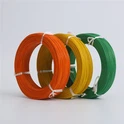
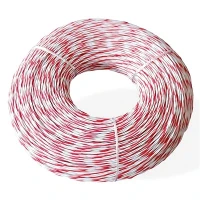
As a supplier of UL20710 multi core copper wire, I often receive inquiries about the abrasion resistance of our products. Abrasion resistance is a crucial factor in many applications, especially those where the wire is subject to friction, rubbing, or movement. In this blog post, I will delve into the topic of whether UL20710 wire is resistant to abrasion, exploring the factors that influence its abrasion resistance and how it performs in real world scenarios.
Based on our company's years of production experience and customer feedback, the wear resistance of UL20710 multi-core copper wire can truly withstand the test of the vast majority of scenarios, even in harsh environments that require frequent movement and repeated friction.
But one thing to clarify is that its wear resistance does not rely on "hard carrying", nor does it come out of thin air. It relies entirely on solid materials and structural design, which is also the confidence of our Zhejiang IRONFLON cable manufacturer. Someone may ask, what exactly is UL20710? In fact, it is a standard certified by UL in the United States. The multi-core copper wire that can pass this certification has strict quality requirements, and wear resistance is just one of its basic advantages.
Let's talk about the outermost layer, it's the first line of defense against wear and tear. We use FEP fluoroplastic insulation layer, a durable and smooth material. Its friction coefficient is particularly low, whether it is rubbing against the machine shell, rubbing against the inner wall of the pipeline, or even rubbing against multiple cables squeezed together, it can minimize wear to the greatest extent possible.
Unlike some ordinary PVC sheathed cables on the market, which become hairy and crack after a few grinds, and need to be replaced soon. Moreover, this FEP material is particularly resistant to high temperatures and corrosion. Even in high-temperature environments in industrial workshops, it will not become soft or sticky, and its wear resistance will not be affected at all.
Speaking of the internal structure, it is also another major secret of its durability and wear resistance. UL20710 is not a single thick copper wire, but is made up of many thin copper wires twisted together, which is much softer than a single core wire. Narrow and complex environments such as car interiors and industrial robot joints make single core wires hard and difficult to wire, and are also prone to breakage. The twisted structure of UL20710 can be easily bent and adapted to various complex scenarios. More importantly, the overall integrity of the twisted copper core is particularly strong. Even if there is slight wear on the outer layer, the fine copper wires inside will not easily break, and it can continue to stably transmit signals and power, which is equivalent to an additional layer of protection.


Just talking about materials and structures may not be clear to everyone. Instead, let's talk about the real usage scenarios that our customers have reported in our actual supply. Whether they are good to use or not, practical experience is the most convincing. The most memorable experience was for a customer who specializes in automotive parts processing. Their workshop's automated production line required cables to constantly move and bend along with the robot arm, as well as repeatedly rub against metal equipment and brackets. Previously, they used multi-core wires from other brands. In less than 3 months, the outer layer was worn out and the equipment would stop running frequently, causing delays in production and requiring time to replace cables and repair equipment, which was particularly troublesome.
Later, through a friend's introduction, they switched to our UL20710 multi-core copper wire. It has been almost a year now, and when our company's salesperson followed up, they reported that the cable sheath is still intact and undamaged. Even in areas that are frequently rubbed, there are only slight scratches, which do not affect normal use at all.
Actually, this is not surprising. Our FEP outer skin is not only wear-resistant, but also very flexible. The robot arm repeatedly bends, and it will not age or crack, so it does not need to be replaced frequently, saving a lot of manpower and costs. That's also why more and more industrial automation workshops are willing to choose UL20710 multi-core copper wire.
In addition to industrial workshops, the internal wiring of automobiles is also a scenario that tests the wear resistance of cables. As we all know, the interior space of a car is particularly compact, and cables have to pass through areas such as the dashboard, doors, and engine compartment. They not only have to be squeezed, but also withstand the vibration of the engine during operation, resulting in a particularly high friction frequency. Our company's UL20710 multi-core wire has been optimized specifically for the automotive industry, with a tighter outer skin and stronger toughness. Even if it is subjected to long-term compression, vibration, and friction, there will be no peeling of the outer skin or exposed copper core. Moreover, its temperature resistance range is particularly wide, ranging from -65 ℃ to 200 ℃. Whether it is the high temperature in the engine compartment or the severe cold in northern winter, it will not affect its wear resistance and transmission effect. Now our cable has been matched with multiple car manufacturers, and the feedback is very stable. Whether it is car ECU, lighting system, or sensor wiring, it can be perfectly adapted.
It can be seen not only in the industrial and automotive fields, but also in daily civilian and commercial equipment. For example, the central control wiring of smart homes needs to pass through walls and furniture gaps, which inevitably causes friction with walls and wood; The internal wiring of medical equipment also requires frequent disassembly and movement, with particularly high requirements for wear resistance and flexibility.
However, to be honest, although UL20710 multi-core copper wire is very wear-resistant, it is not "omnipotent" either. For example, try not to expose it to sharp objects for a long time, such as sharp metal edges, burrs, and even the most wear-resistant outer skin, which will be damaged by long-term scratching. It is recommended that when wiring, try to avoid these sharp areas or cover them with protective tubes, which can greatly extend the service life of the cable.
Another issue is the strong corrosive environment. Although FEP outer skin has a certain degree of corrosion resistance, long-term exposure to strong acids, alkalis, and other substances can still affect the wear resistance and service life of the outer skin. If your usage scenario is quite special and in a highly corrosive environment, don't panic. Communicate with us in advance, and we can customize a more corrosion-resistant solution according to your specific scenario, customized as needed.
By now, everyone should understand that the wear resistance of UL20710 multi-core copper wire is truly confident. The dual protection of FEP outer skin and twisted copper core can withstand the friction test in most scenarios, and has passed UL certification. It is safe, durable, and has stable transmission without frequent replacement, which can help everyone save a lot of time and cost.
As a supplier of Zhejiang IRONFLON Wire&Cable, we strictly control every step from raw material procurement, production and processing, to finished product testing, in order to ensure that our customers can use them with confidence. Whether you are in industrial automation, automotive manufacturing, medical or communication equipment, as long as you have a need for UL20710 multi-core copper wire, feel free to contact us anytime.