Hey there! As a supplier of UL1671 tin plated ETFE insulated wire, I often get asked about all sorts of technical details regarding this product. One question that pops up quite a bit is, "What is the phase velocity of UL1671 tin plated ETFE insulated wire?" Well, let's dive right into it and break it down in a way that's easy to understand.
First off, let's talk a bit about what UL1671 tin plated ETFE insulated wire is. UL1671 is a specific standard that this wire meets. The tin plating on the wire serves several purposes. It provides better conductivity, corrosion resistance, and solderability. And the ETFE (Ethylene Tetrafluoroethylene) insulation is pretty awesome too. It's known for being high heat resistant wire, chemically stable, and having good mechanical properties. This makes the wire suitable for a wide range of applications, from aerospace to industrial electronics.
Now, onto the phase velocity. Phase velocity is basically the speed at which a particular phase of an electromagnetic wave travels through a medium. In the case of our UL1671 tin plated ETFE insulated wire, the medium is the wire itself, including the tin plating and the ETFE insulation.
The phase velocity of a wire depends on a few factors. One of the most important ones is the dielectric constant of the insulation material. The dielectric constant is a measure of how much an electric field can be stored in a material. For ETFE, it has a relatively low dielectric constant compared to some other insulation materials. A lower dielectric constant generally means a higher phase velocity.
Mathematically, the phase velocity (v) can be calculated using the formula v = c / √εr, where c is the speed of light in a vacuum (approximately 3 x 10^8 meters per second) and εr is the relative dielectric constant of the insulation material. For ETFE, the relative dielectric constant is typically around 2.6 at room temperature. So, if we plug this value into the formula, we get v = (3 x 10^8 m/s) / √2.6 ≈ 1.86 x 10^8 m/s.
But it's important to note that this is a simplified calculation. In reality, the phase velocity can be affected by other factors too. For example, the shape and size of the wire can have an impact. A thicker wire might have a slightly different phase velocity compared to a thinner one. Also, the frequency of the electromagnetic wave traveling through the wire matters. At different frequencies, the dielectric properties of the ETFE insulation can change slightly, which in turn affects the phase velocity.
Another thing to consider is the tin plating. The tin plating can interact with the electromagnetic wave in a way that might influence the phase velocity. However, since the tin plating is relatively thin compared to the overall size of the wire, its effect on the phase velocity is usually not as significant as the dielectric properties of the ETFE insulation.
Now, let's talk about why the phase velocity is important. In applications where precise timing is crucial, such as in high - speed data transmission or certain types of communication systems, the phase velocity can have a big impact. If the phase velocity is too slow or varies too much, it can lead to signal distortion, delays, and errors in data transmission. So, having a wire with a consistent and appropriate phase velocity is essential for reliable performance.
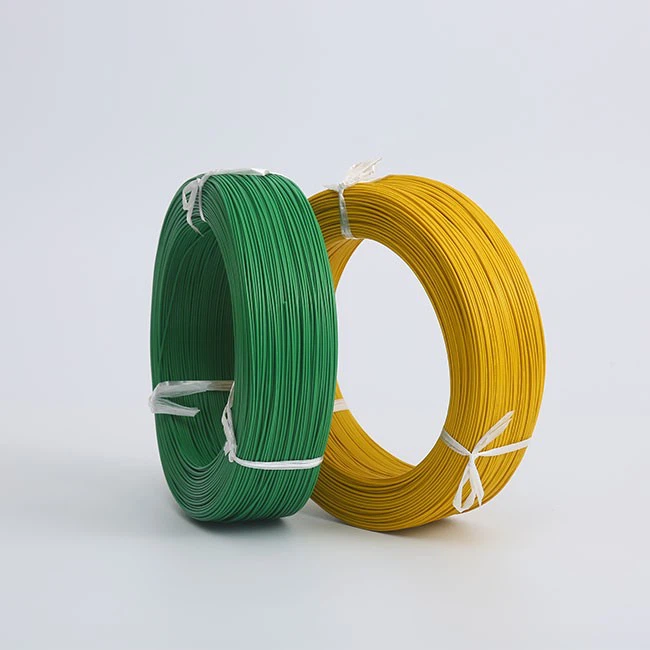

Our UL1671 tin plated ETFE insulated wire is designed to provide a stable phase velocity within a certain range. We've done a lot of testing and quality control to ensure that the wire meets the requirements of various applications. Whether you're working on a project that requires high - speed data transfer or a system that needs to operate in a high - temperature environment, our wire can be a great choice.
In addition to UL1671, we also offer other types of wires that might be suitable for your needs. For example, our UL10086 Teflon wire is another option. Teflon has its own unique properties, such as even higher heat resistance and excellent chemical inertness. And our UL1516 High quality wire is known for its high - quality construction and reliable performance.
If you're in the market for insulated wires and have questions about phase velocity, dielectric constants, or any other technical aspects, don't hesitate to reach out. We're here to help you find the right wire for your project. Whether you're a small electronics hobbyist or a large industrial manufacturer, we can provide you with the products and support you need.
So, if you're interested in learning more about our UL1671 tin plated ETFE insulated wire or any of our other products, just drop us a line. We'll be happy to discuss your requirements and provide you with a quote. Let's work together to make your project a success!
References
- "Electromagnetic Waves and Radiating Systems" by John D. Kraus
- Manufacturer's specifications for ETFE insulation materials