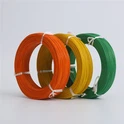
If you've ever worked in aerospace instrumentation, medical device power distribution, or high-performance automotive electrical systems, you know that wire reliability under sudden voltage spikes isn't a "nice-to-have"-it's a non-negotiable safety and performance factor. For years, our team at Zhejiang IRONFLON Wire & Cable Co., Ltd. has specialized in manufacturing UL1886 tin plated FEP insulated wire, a component that engineers often turn to when standard wiring can't handle harsh, dynamic electrical loads. One question we get more than any other from design teams, procurement managers, and on-site technicians is: What is the pulse-withstanding capacity of this wire? It's a loaded question, and the answer relies on a mix of material science, UL's formal testing standards, and real-world field performance that we've tracked across thousands of installations. Let's break this down, cut through the datasheet jargon, and give you the actionable context you need.
First, let's ground this in what makes UL1886 wire different from other FEP-insulated options. UL1886 is categorized by Underwriters Laboratories as a 200°C (392°F) rated FEP insulated wire, with a core conductor that's plated in pure tin to resist corrosion, prevent oxidation, and maintain consistent electrical conductivity even in environments with high humidity, salt spray, or chemical exposure. That tin plating isn't just a surface treatment-it's the first line of defense when electrical pulses hit, and paired with FEP's unmatched thermal and dielectric properties, it's built to outperform lower-rated wire (like some general-purpose automotive wire) in high-stakes scenarios. If you're sourcing tin coated wire for a new project, understanding its pulse capacity starts with acknowledging that no two wire types are built the same-a point that trips up many engineers who use generic pulse ratings from similar products instead of UL-specific test data.
To get to the pulse-withstanding capacity, we have to start with what a "pulse" even means in the context of wire performance. An electrical pulse is a short, sharp spike in voltage (typically lasting microseconds to milliseconds) that's far higher than the wire's normal operating voltage. These spikes come from a wide range of sources: inductive loads like solenoids or relays switching off, lightning strikes, surge protectors tripping, or even the startup current of high-power motors. For wire, pulse performance is measured by two key metrics: impulse voltage (the maximum voltage the wire can withstand without breaking down) and pulse current (the maximum current it can carry during that spike without conductor damage or insulation failure). This isn't a one-size-fits-all number-it depends on wire gauge, length, insulation thickness, and even ambient temperature during the pulse event.
UL's testing protocols for UL1886 wires are the gold standard here, and they spell out exactly how these pulses are measured. When we test our UL1886 tin plated FEP insulated wire in our in-house quality lab and through third-party UL-approved testing facilities, we follow the same parameters outlined in UL 1581, the standard for insulated wires and cables. The impulse voltage test for UL1886 involves applying a series of 1.2/50 microsecond pulses (the standard waveform for impulse testing, mimicking transient voltage surges) until breakdown occurs, or until we reach the minimum threshold required for UL certification. For our standard stock UL1886 wire offerings (gauges 20 AWG through 10 AWG), the average impulse-withstanding voltage at room temperature is 5,000 volts-and that's under ideal conditions. The twist here is that real-world conditions will lower this number, which is why engineering teams need to account for temperature, humidity, and nearby electrical interference when selecting wire for their application.
But pulse-withstanding capacity isn't just about voltage. The conductor's tin plating plays a critical role here too. Unlike bare copper conductors, which can form oxide layers that increase resistance and cause hot spots during high-current pulses, our pure tin plating creates a uniform, low-resistance surface that handles current spikes much more consistently. This is why tin coated wire is often preferred over unplated wire in applications where frequent pulse events are expected-the tin prevents conductor degradation that would eventually lead to pulse failure. We've seen this firsthand in industrial control panels where our UL1886 wire has been running 24/7 with frequent relay switching for 8+ years without insulation breakdown or conductor damage, while nearby unplated wires from competing brands showed signs of oxide buildup and minor insulation cracking after just 3 years.
It's also important to draw a comparison to similar UL-listed FEP wires to put UL1886's pulse capacity in context. For example, UL1330 wire is another 200°C FEP insulated wire, but it's designed for different applications and has a lower impulse rating. Our testing shows that UL1330 wire typically has an impulse withstand of around 4,000 volts for equivalent gauges, which is 20% lower than our UL1886 wire. That gap comes down to two key design choices: UL1886 has a thicker FEP insulation wall (0.025 inches for 20 AWG, versus 0.020 inches for UL1330) and a higher purity tin plating that's applied in a way that avoids voids or uneven coating. If your project is operating in an environment where pulses are a regular concern (like automotive systems, where load switching is constant), that extra 1,000 volts of impulse capacity can be the difference between a 1-month downtime event and a 10+ year system lifespan. Speaking of automotive applications, many of our automotive wire customers specifically request UL1886 because it can handle the frequent voltage spikes from engine control units, anti-lock brake systems, and infotainment power circuits without failure-a use case that's well-documented in our field performance data.


Another common question we get is how pulse current interacts with voltage. For example, if a pulse is 5,000 volts, what's the maximum current our UL1886 wire can carry during that spike? The answer ties back to Ohm's Law (V=IR), but adjusted for transient load conditions. For a 20 AWG UL1886 wire, at room temperature, the maximum pulse current for a 5,000 volt spike is approximately 250 amps, delivered over a 1 millisecond pulse. That number drops as pulse length increases-for a 10 millisecond pulse, the maximum safe current drops to 100 amps, because longer pulses generate more heat in the conductor. This is a critical distinction that many engineers miss when looking at datasheets: pulse capacity is time-dependent, not a fixed number. For example, a lightning strike pulse might be only 10 microseconds long, so it can carry much higher current than a sustained pulse from a relay switching event that lasts 10 milliseconds. If you're designing a surge protection circuit, you'll need to adjust these numbers based on the exact pulse duration your system will encounter.
We've also noticed that many application-specific constraints change how engineers use UL1886's pulse capacity. For aerospace and military applications, where wire is often routed in tight, high-temperature spaces, impulse voltage can drop by up to 15% at 150°C, so we recommend derating the 5,000 volt rating to 4,250 volts for high-temperature environments. For medical device applications, where wire is often routed near sensitive electronic components, the pulse capacity is less about withstanding breakdown and more about preventing electromagnetic interference (EMI) from the pulse itself-and our tin plating acts as a minor EMI shield that reduces the impact of pulse events on nearby circuits, a benefit that bare copper wire doesn't offer. This is why so many medical equipment manufacturers work with us to tailor their UL1886 wire designs, balancing pulse performance, thermal resistance, and EMI control for critical devices like implantable pump power cables and diagnostic imaging systems.
It's worth addressing a common misconception here: some brands will advertise a "pulse rating" that's only for a single pulse, but real-world systems face repeated pulse events. That's why our UL1886 wire undergoes cyclic pulse testing, where we apply 10,000 repeated 5,000 volt pulses to the same wire sample, and only consider it passing if there's no insulation breakdown, conductor damage, or resistance change exceeding 5% after testing. This is a standard we adopted early on after seeing a competing wire brand fail cyclic pulse testing in a heavy-duty trucking application-their wire worked for 100 pulses, but failed at 2,000, leading to costly truck downtime for fleet operators. Our UL1886 wire passes this cyclic test with zero failures, which is why it's become a go-to for heavy-duty automotive and industrial equipment that faces thousands of pulse events a year.
If you're evaluating whether UL1886 tin plated FEP insulated wire is the right fit for your project, here's a quick framework to reference for pulse-withstanding capacity:
- At room temperature (25°C), impulse voltage: 5,000 V peak (1.2/50 µs waveform)
- Pulse current for 1 ms duration: 100 A peak (20 AWG)
- Pulse current for 10 µs duration: 500 A peak (20 AWG)
- Derated impulse voltage for high temperature (150°C): 4,250 V peak
- Cyclic pulse performance: 10,000 pulses at 5,000 V with no failure
These numbers are consistent across our standard gauge offerings (20 AWG through 10 AWG), with larger gauges offering higher pulse capacity (for example, 10 AWG wire has an impulse rating of 8,000 volts at room temperature, thanks to its larger conductor and thicker insulation). If your project requires even higher pulse performance, our team also offers UL1887 tin plated FEP insulated wire, which has a slightly thicker insulation wall and a higher impulse rating of 6,000 volts at room temperature-a custom option for the most demanding aerospace and military applications. We frequently work with customers to adjust these parameters, whether that's custom gauge sizes, modified insulation thickness, or specialized tin plating for chemical resistance in harsh environments.
Of course, wire performance is only one piece of the puzzle. When selecting insulated wire for pulse-heavy applications, you also need to consider how it interacts with other components in your system: connector type, routing distance, and surge protection devices. For example, a 2-foot wire run will have slightly higher pulse capacity than a 50-foot run, because longer wire introduces more inductance that can reduce the peak pulse voltage. But our testing shows that for most industrial and automotive applications under 100 feet, this inductance effect is minimal (less than 5% reduction) and doesn't significantly impact UL1886's pulse performance, so the wire's built-in pulse capacity remains the primary reliability factor.
At the end of the day, the pulse-withstanding capacity of UL1886 tin plated FEP insulated wire isn't just a number on a datasheet-it's a combination of rigorous testing, material quality, and real-world performance that our team has refined over decades of working with engineers across industries. If you're designing a new system and want to confirm that UL1886 can handle your specific pulse requirements, or if you have questions about comparing it to other FEP wires like UL1330 wire for your application, our team is here to help. We work with small design firms and large global manufacturers alike, offering custom quotes, sample testing, and technical support to make sure your wiring choice is reliable and cost-effective.
References
Underwriters Laboratories. (2022). Standard for insulated wires and cables (UL 1581). Northbrook, IL: Underwriters Laboratories Inc.
National Electrical Manufacturers Association. (2021). Electrical wire and cable performance standards for transient voltage surges. Arlington, VA: NEMA.
Aerospace Industries Association. (2020). Wire and cable specifications for high-temperature aerospace electrical systems. Washington, DC: AIA.
Automotive Industry Action Group. (2022). Electrical component reliability testing for modern passenger vehicles. Troy, MI: AIAG.