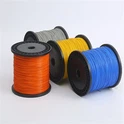
Hey there! As a supplier of UL10316 single core copper wire, I often get asked about the water absorption rate of its insulation. It's a crucial factor, especially when you're using these wires in various environments. So, let's dive right into it and understand what this water absorption rate is all about.
The reason why UL10316 can become a popular wiring product in various industries is due to its insulation material. This wire does not use the PVC or rubber insulation of ordinary wires on the market, but is equipped with ETFE insulation layer with better comprehensive performance.
ETFE is a high-quality material that balances toughness, stability, and weather resistance. Its texture is flexible and not brittle, and it can withstand high temperature baking as well as daily acid and alkali corrosion. It has ultimate hydrophobic and moisture resistant properties, which is also the core reason for its extremely low water absorption rate. The commonly used specifications cover 32AWG-12AWG, with conductors made of tin plated or bare copper material, suitable for 600V normal working conditions, with a wide temperature range of -80 ℃ to 125 ℃, and can easily handle the internal wiring scenarios of most civilian and industrial equipment.
According to the industry standard ASTM D570, after soaking in distilled water at room temperature of 23 ℃ for 24 hours, the water absorption rate of UL10316 ETFE insulation layer is ≤ 0.03%. Compared to ordinary wires, the common PVC insulated wires on the market generally have a water absorption rate of 0.5% -1.5%. Even rubber wires with good moisture resistance can achieve a water absorption rate of 0.3% -0.8%.
This means that if soaked in water for a whole day, the insulation layer of ordinary wires will seep in a lot of moisture, and the internal structure will gradually become soft due to moisture; The insulation layer of UL10316 hardly absorbs water, equivalent to all-weather water isolation.
In the unique molecular structure of ETFE, fluorine atoms tightly wrap around the carbon main chain, forming a dense and stable molecular protective film. This invisible barrier has extremely strong sealing properties, and water molecules have no gaps to penetrate, fundamentally eliminating problems of water absorption, moisture absorption, and hydrolysis.
It is precisely because of this characteristic that UL10316 performs exceptionally well in high humidity environments. In industrial production areas with outdoor equipment, kitchen and bathroom appliances, and high levels of water mist, many ordinary wires may experience insulation swelling, softening, and leakage hazards after six months of use. However, UL10316 can maintain stable insulation resistance and dielectric properties even in environments with high temperature, and water vapor diffusion for a long time, and will not experience performance degradation due to moisture.
The ultra-low water absorption characteristics of UL10316 can perfectly avoid these high-frequency pain points. Not absorbing water means that the insulation performance is always online and will not fluctuate due to changes in environmental humidity, providing a solid guarantee for the safety and stability of equipment operation. At the same time, the aging problem caused by water vapor erosion is eliminated, and the service life of the wire is greatly extended, without frequent maintenance and replacement. The cost-effectiveness of long-term use is extremely high.
That's why this wire is widely used in harsh scenarios such as new energy equipment, precision electronic instruments, industrial heating equipment, and automotive peripheral wiring.
The ultra-low insulation and water absorption rate of UL10316 single core copper wire may seem like an inconspicuous small parameter, but it is actually a key guarantee for the long-term stable operation of the equipment. As the main hot selling product of Zhejiang IRONFLON, we strictly control the selection of raw materials and production processes throughout the process. The water absorption rate, temperature resistance, flame retardancy, and corrosion resistance of each batch of wire are strictly inspected to prevent defective products from leaving the factory.