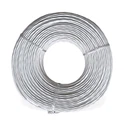
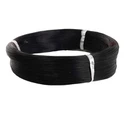
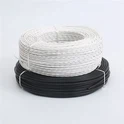
In the realm of electrical engineering and wire manufacturing, understanding the properties of different types of wires is crucial for various applications. One such wire that has gained significant attention is the UL1332 tin plated FEP insulated wire. As a supplier of UL1332 tin plated FEP insulated wire, I am often asked about its permittivity, a fundamental electrical property that plays a vital role in its performance. In this blog post, I will delve into the concept of permittivity, explain its significance for UL1332 tin plated FEP insulated wire, and provide some insights based on my experience in the industry.
What is Permittivity?
Permittivity, denoted by the Greek letter ε (epsilon), is a measure of how much electric field a material can store or polarize. In simpler terms, it describes the ability of a material to support the formation of an electric field within it. The permittivity of a vacuum, denoted as ε₀, is a fundamental physical constant with a value of approximately 8.854 x 10⁻¹² F/m (farads per meter). When a material is placed in an electric field, its permittivity is relative to that of a vacuum, and this relative permittivity, also known as the dielectric constant (κ), is defined as the ratio of the permittivity of the material (ε) to the permittivity of a vacuum (ε₀):
κ = ε / ε₀
The dielectric constant is a dimensionless quantity that indicates how much more electric field a material can store compared to a vacuum. Materials with a high dielectric constant can store more electric field energy, while those with a low dielectric constant allow electric fields to pass through more easily.
Permittivity of FEP Insulation
Fluorinated ethylene propylene (FEP) is a fluoropolymer known for its excellent electrical insulation properties, chemical resistance, and thermal stability. It is commonly used as an insulation material for wires and cables in various industries, including aerospace, electronics, and telecommunications. The permittivity of FEP is relatively low, typically around 2.1 at room temperature and low frequencies. This low permittivity makes FEP an ideal choice for applications where signal integrity and low loss are critical, such as high-speed data transmission and high-frequency circuits.
The low permittivity of FEP insulation offers several advantages for UL1332 tin plated FEP insulated wire. First, it reduces the capacitance of the wire, which is the ability of the wire to store electrical energy in an electric field. Lower capacitance means less signal distortion and attenuation, resulting in better signal quality and higher data transfer rates. Second, the low permittivity of FEP insulation minimizes the dielectric losses, which are the losses of electrical energy due to the absorption and dissipation of the electric field in the insulation material. Lower dielectric losses translate to higher efficiency and less power consumption in electrical circuits.
Factors Affecting the Permittivity of UL1332 Tin Plated FEP Insulated Wire
While the permittivity of FEP insulation is relatively stable under normal conditions, it can be affected by several factors, including temperature, frequency, and the presence of impurities or additives.
Temperature
The permittivity of FEP insulation generally increases with increasing temperature. This is because as the temperature rises, the molecular motion of the FEP polymer increases, leading to a greater polarization of the molecules and a higher ability to store electric field energy. However, the change in permittivity with temperature is relatively small for FEP, typically less than 0.1% per degree Celsius over a wide temperature range.
Frequency
The permittivity of FEP insulation also varies with frequency. At low frequencies, the permittivity of FEP is relatively constant, but as the frequency increases, the permittivity may decrease slightly due to the relaxation of the polarization mechanisms in the FEP polymer. This frequency dependence of permittivity is known as dielectric dispersion and can have a significant impact on the performance of UL1332 tin plated FEP insulated wire at high frequencies.
Impurities and Additives
The presence of impurities or additives in the FEP insulation can also affect its permittivity. For example, the addition of fillers or pigments to improve the mechanical or thermal properties of the insulation may increase the permittivity of the material. Similarly, the presence of moisture or other contaminants in the insulation can also increase the permittivity and cause dielectric losses. Therefore, it is important to ensure the quality and purity of the FEP insulation material used in UL1332 tin plated FEP insulated wire to maintain its low permittivity and excellent electrical performance.
Applications of UL1332 Tin Plated FEP Insulated Wire
The low permittivity and excellent electrical properties of UL1332 tin plated FEP insulated wire make it suitable for a wide range of applications, including:
- High-Speed Data Transmission: UL1332 tin plated FEP insulated wire is commonly used in high-speed data transmission applications, such as Ethernet cables, USB cables, and fiber optic connectors. The low capacitance and low dielectric losses of the wire ensure reliable and high-speed data transfer with minimal signal distortion.
- High-Frequency Circuits: In high-frequency circuits, such as radio frequency (RF) and microwave circuits, UL1332 tin plated FEP insulated wire is used to minimize signal loss and interference. The low permittivity of FEP insulation allows for efficient transmission of high-frequency signals with reduced attenuation and better impedance matching.
- Aerospace and Defense: The aerospace and defense industries require wires and cables that can withstand harsh environments and provide reliable performance. UL1332 tin plated FEP insulated wire is widely used in these industries due to its excellent chemical resistance, thermal stability, and low flammability.
Comparison with Other Types of FEP Insulated Wires
In addition to UL1332 tin plated FEP insulated wire, there are other types of FEP insulated wires available in the market, such as UL1330 FEP Wire and UL1333 FEP Wire. While these wires also use FEP insulation, they may have different specifications and applications.
UL1330 FEP wire is typically used for general-purpose applications where flexibility and durability are required. It has a smaller diameter and a lower voltage rating compared to UL1332 tin plated FEP insulated wire. UL1333 FEP wire, on the other hand, is designed for high-temperature applications and has a higher temperature rating than UL1332 tin plated FEP insulated wire.
Another type of FEP insulated wire is UL10045 Tin Plated FEP Insulated Wire, which is similar to UL1332 tin plated FEP insulated wire but may have different insulation thickness and conductor size. The choice of the appropriate FEP insulated wire depends on the specific requirements of the application, such as voltage rating, temperature range, and mechanical properties.


Conclusion
In conclusion, the permittivity of UL1332 tin plated FEP insulated wire is an important electrical property that affects its performance in various applications. The low permittivity of FEP insulation offers several advantages, including low capacitance, low dielectric losses, and excellent signal integrity. While the permittivity of FEP insulation is relatively stable under normal conditions, it can be affected by factors such as temperature, frequency, and the presence of impurities or additives. As a supplier of UL1332 tin plated FEP insulated wire, we ensure the quality and consistency of our products by using high-quality FEP insulation material and strict manufacturing processes.
If you are looking for a reliable supplier of UL1332 tin plated FEP insulated wire or have any questions about the permittivity or other properties of our products, please feel free to contact us for further information and to discuss your specific requirements. We are committed to providing our customers with the highest quality products and excellent customer service.
References
- "Fluoropolymers," Encyclopedia of Polymer Science and Technology, John Wiley & Sons, Inc., 2003.
- "Electrical Properties of Polymers," Handbook of Polymer Science and Technology, Marcel Dekker, Inc., 1990.
- "UL 1332 Standard for Safety: Thermoplastic-Insulated and Jacketed Wires and Cables for Use in Electric Power Circuits," Underwriters Laboratories, Inc., 2019.